I can see a pushout of an cofibration is a cofibration, but how to show the case of acyclic cofibration (acyclic cofibration means a H-cofiration as well as a homotopy equivalence)?
2026-03-28 12:14:41.1774700081
 On
On
A pushout of an acyclic cofibration is an acyclic cofibration
622 Views Asked by Bumbble Comm https://math.techqa.club/user/bumbble-comm/detail At
2
There are 2 best solutions below
1
On
This follows from a gluing theorem for homotopy equivalences. Consider the following diagram
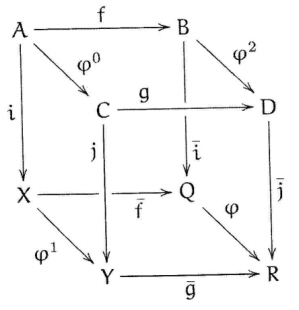
which is diagram 7.5.6 of Topology and Groupoids. It is supposed to be a commutative diagram in which $i,j$ are closed cofibrations. $\varphi^0,\varphi^1,\varphi^2$ are homotopy equivalences, and the front and back faces are pushouts. The theorem is that then $\varphi$ is a homotopy equivalence. The case you want is when
$X,C$ are replaced by $A$;
$Y$ is replaced by $X$;
$Q,D$ are replaced by $B$;
and I leave you to decide how to replace the maps!
You end up with $R= B \cup_fX$ and $B \to R$ is a homotopy equivalence.
Let $f': X' \to Y'$ be a pushout of a map $f: X \to Y$. Then $f'$ acquires LLP with respect to any map for which $f$ has LLP. As mentioned in the comments, acyclic cofibrations are characterized as those maps having LLP with respect to all fibrations, so $f'$ inherits this property from $f$. A proof of the characterization of trivial cofibrations can be found in Homotopical Algebra, Lemma 4 in Section II.3.4.
The question here should reduce to (i) implies (iii) from this lemma: that an acyclic cofibration is an sdr (then it should be easy to see that the pushout of an sdr is an sdr, in particular an equivalence).
The proof goes by considering the factorization of $X \to Y$ as $$X \overset{i}\to X\times_Y PY \overset{p}\to Y$$ A section of the fibration $p$ is the same data as an sdr of $f$. Since $i$ is an sdr and $p\circ i$ is an equivalence, by 2 out of 3 then $p$ is an acyclic fibration. As $X \to Y$ is a cofibration, the desired section exists.