I feel like this is such a simple question but I am at such a loss. I currently have a set of values that I would like to weigh by an S Curve. My data ranges from $0$ to $1$ and never leaves those bounds, but nearly every version of a Sigmoid I see assumes $x = 0$ is the point of inflection. Furthermore many of the Sigmoids reach y=0 at approximately $x = -6$, and $y=1$ at approx $x= 6$. However in my case I need to reach $y=0$ at $x=0$ and $y=1$ at $x=1$, and the point to of inflection to be at $x = 0.5$.
To summarize I need a S Curve that meets the following requirements..
- $x$ from $0$ to $1$
- $y$ from $0$ to $1$
- $0$ remains $0$ and $1$ remains $1$
- Adjustable shape for different Curves
- Bonus If I can adjust the point of inflection while maintaining the above
Here is an example of the above (except for a movable inflection) http://www.guillermoluijk.com/misc/contrast.gif
I have looked at Sigmoids, Logistics, tan and sing approximations, contrast and AI equations, and nothing quite gets me what I need. Any explanation to go along with an answer would be much appreciated!


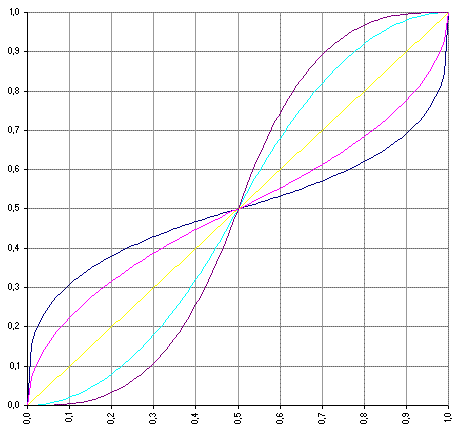
Select one extreme "setting" of your curve (eg, the magenta curve in your link).Define your criteria for this shape a bit more carefully, eg: $f(0) = 0$, $f(.5) = .5$, $f(1) = 1$, and function is both continuous and differentiable everywhere. Furthermore, $f(x) > x$ for $0 < x < .5$ and $f(x) > x$ for $.5 < x < 1$.
Divide it in two at what you call the "inflection point" ($x=.5$).
Construct a piecewise smooth function in two pieces (one below $.5$ and one above) with the properties selected in step 1. I recommend using trig functions, but exponential and log functions can be made to work as well. I will call this function $g(x)$. One possibility is given by: $$ .5 sin( 10x/pi ), x\leq.5 \\ -.5 sin( 10x/pi )+1, x>.5 $$ Other options exist, of course.
To achieve other, less extreme, curves in the same family, interpolate linearly, between $g(x)$ and $x$, eg: $f(x) = a * g(x) + (1-a) * x$, where $0 < a < 1$. To other curves in the same family but in the other direction, you will have to extrapolate, but this is simple: $f(x) = a * g(x) + (1-a) * x$, where $-1 < a < 0$. Thus, the complete family is given simply by $f(x) = a * g(x) + (1-a) * x$, where $-1 < a < 1$.