Looking here

(source: djoyce at mathcs.clarku.edu)
If at each crossover point you imagine a machine in the cloud executing code, and the machines are connected to the 4 other nearby machines, can you physically distribute these machines such that they are spread out in space like across the earth (or just in space in general), and at the same time they are geographically laid out like this tessellation?
Put another way, can the nodes be spatially arranged at each crossing point such that it forms this hyperbolic tessellation?
I am just not sure as it gets out on the fringes if it would be considered like wrapping around the 3D earth, or if as you go further out, the nodes would need to be further apart.
I am doing an experiment with laying out virtual compute nodes and want to connect them in this pattern, but not sure if it's physically possible.

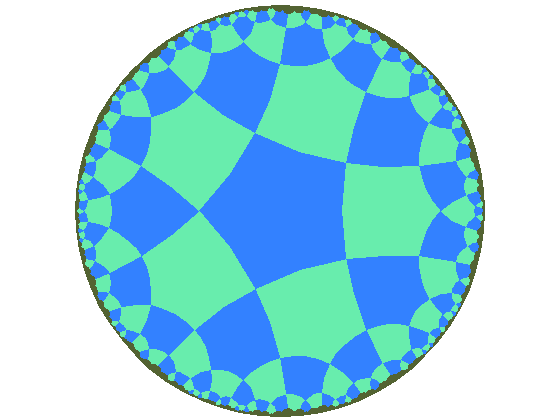
Here's the problem.
Each node will take up some minimum amount of area (if layed out on the surface of the earth) or volume (if arrayed in space). Let's use $A$ to denote this amount.
Now let's count nodes:
To put this concisely, the number of nodes which exist at distance $\le n$ is growing exponentially, faster than the exponential function $2^n$. There's actually an exponential growth base larger than $2$, but $2$ is pretty easy to see if you stare at that diagram, and it's already large enough to be able to see the looming disaster.
So, the total amount of area/volume occupied by the nodes at distance $\le n$ is at least as large as $A \cdot 2^n$.
But now we encounter a serious problem: In our universe, the nearby geometry (out to, say, the nearest galactic cluster) is very closely approximated by a Euclidean metric. And the amount of volume in a space of radius $n$ is growing only cubically. The exact Euclidean volume of a ball of radius $n$ in Euclidean space is $\frac{4\pi}{3} n^3$, and with the tiny perturbations of metric arising from general relativity, the actual volume formula is going to be very very close to the exact Euclidean formula, going out a very very large distance.
So you're gonna run out of space pretty quickly if you actually try to build this cloud machine.