I am trying to wrap my head around conditional expectations wrt sub-$\sigma$-algebras. Sorry if this question is confusing, I tried my best!
I have trouble understanding the following illustration (from Wikipedia):
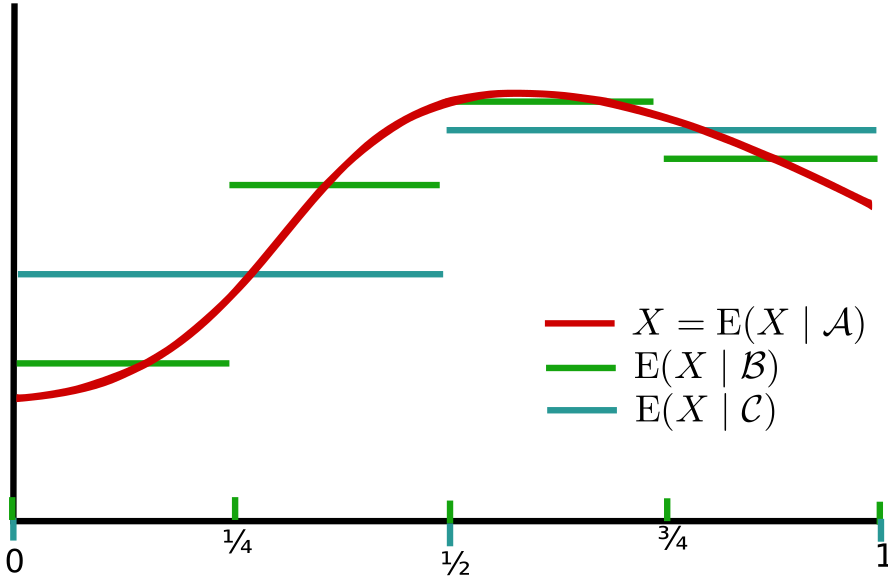
Here, the probability space is $(\Omega,\mathcal{F},P)$ with $\Omega = [0,1]$, with the $\sigma$-algebra being the borel set (I suppose) and $P$ being the Lebesgue-measure. Furthermore $\mathcal{A}=\mathcal{F}$. The other two $\sigma$-algebras are the ones generated by the intervals with endpoints $0,0.25,0.5,0.75,1$ and $0,0.5,1$.
I suppose the red line is suppoesed to illustrate the pdf of $X$ on $(\Omega,\mathcal{F})$, but how is one supposed to interpret $X=E[X|\mathcal{A}]$? Surely $E[X|\mathcal{A}]$ is just a scalar number and is not identifiable with the red graph?
And even assuming it means that $E[X|\mathcal{A}]$ is the average value along the red graph, I don't know what to make of the other graphs. How do they illustrate conditional expectation?