For a linear system $X'=AX$, there are only limited types of critical points according to the eigen values of $A$.
When I want to considering non-linear dynamical system in $\mathbb{R}^2$ and $\mathbb{R}^3$, how to construct the equation with critical points with different qualitative behaviors.
For example, if I want a critical point with monkey saddle, I'm remind of monkey surface $z=x^3-2xy^2$. So the possible system is $(x,y) = Dz=(3x^2-2y^2,-4xy)$.
Two type of behaviors are of particular interest to me.
- hyperbolic sector: curves approach the critical point but never through it. Saddle have 4 four hyperbolic sectors for example.
- elliptic sector: curves start from critical point and end at the same critical point, which never happens in linear case.
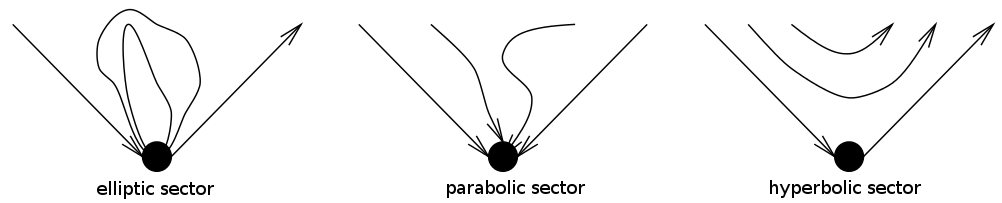
By the way, the sectors in $\mathbb{R}^2$ is obvious. I guess the sectors in $\mathbb{R}^3$ are something like annules on the sphere.


The theory of non-hyperbolic critical points is virtually exhaustive for ${\textbf R}^2$. It can be found in full generality in, e.g., Qualitative Theory of Planar Differential Systems. In short, if a system is given of the form $$ \dot x=f(x,y),\\ \dot y=g(x,y), $$ where $f,g$ are analytic, then the type of the sectors (if the equilibrium is not monodromic) is determined by the structure of Newton's diagram of powers of $f$ and $g$. I am not aware of any theory dealing with the analogous questions in dimensions $\geq 3$.