Does the same determinant make two matrices equal to each other?
If I have:
Find all values of $x$ that make
$$\begin{pmatrix}2 & -1 &4\\3 & 0 & 5\\4 & 1 & 6\end{pmatrix}=\begin{pmatrix} x & 4\\5 & x\end{pmatrix} $$
Would I calculate and equate the determinants of both matrices to solve this problem?
Edit: Below is the exact question. Do the style of brackets refer to the determinants?
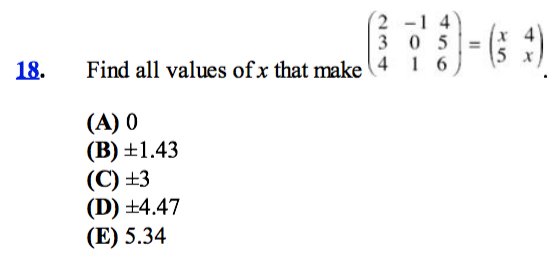

If the problem is about an equality of the determinant, all you have to do is compute the determinants separately. The determinant of the $3\times 3$ matrix is $$ (2)(0)(6) + (-1)(5)(4) + (4)(3)(1) - (4)(0)(4) - (1)(5)(2) - (6)(3)(-1) = 0 - 20 + 12 - 0 - 10 + 18 = 0. $$ The $2\times 2$ determinant is just $x^{2} - 20$. Then, we arrive at the equation $$ 0 = x^{2} - 20 $$ which has two possible solutions: $x=\sqrt{20}$ or $x=-\sqrt{20}$. Thus, the answer is (D) if the question refers to determinants.
If not, then there is no solution.