Here is an image of a hyperbola:
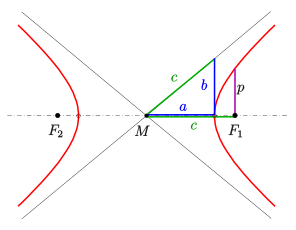
I'm wondering why $c^2=a^2+b^2$ in this drawing given that $c$ is the distance from the origin to both of the foci and $a$ is half the length of the absolute distance between any given point and the two foci.
Sorry if this seems like a stupid question.

Take the foci of the hyperbola $F_1=(c,0)$ and $F_2=(-c,0)$ and the two vertices : $V_1=(a,0)$ and $V_2=(-a,0)$.
From the definition we have that a point $P$ of the hyperbola is such that $\overline{PF_1}-\overline{PF_2}=k$, and using as $P$ a vertex we find that $k=2a$.
So, for $P=(x,y)$ the equation is $$ \sqrt{(x-c)^2+y^2}-\sqrt{(x+c)^2+y^2}=2a $$
squarin two times and with ambit of algebra you can find the equation:
$$ \frac{x^2}{a^2}-\frac{y^2}{c^2-a^2}=1 $$
that becomes $$ \frac{x^2}{a^2}-\frac{y^2}{b^2}=1 $$ with $b^2=c^2-a^2$
and this means that $c^2=a^2+b^2$. Then note that the asymptotes of the hyperbola have slope $\pm\frac{b}{a}$, so the asymptotes intrecept the circle with center the origin and radius $c$ at the points of coordinates $(\pm a,\pm b)$ where $a^2+b^2=c^2$