Basically, I have two images of Julia sets I liked most from a google query
 $\ \ \ $
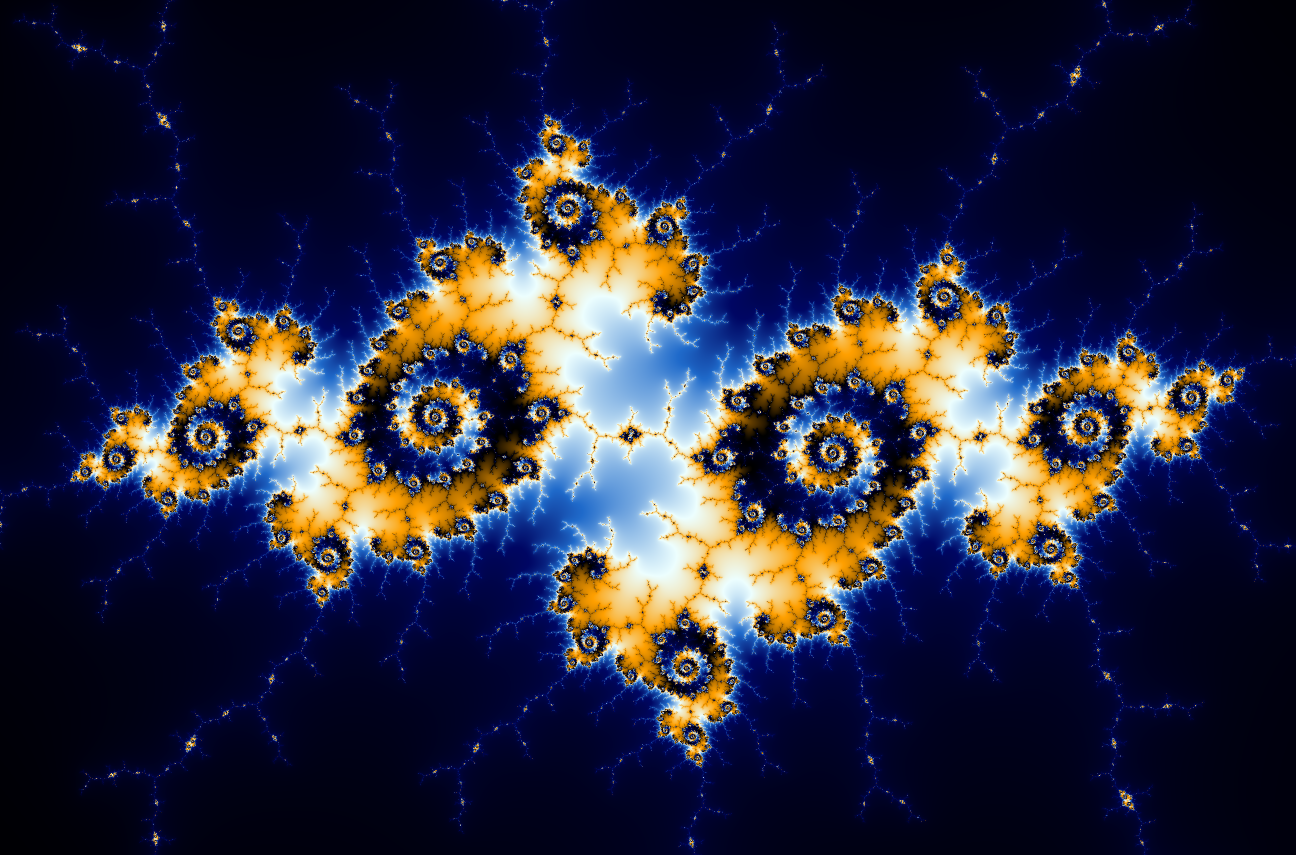
I want
- To be able to produce similar images, for that I need at least a palette from these images.
- To know the parameter $c$ for each of these images (for the process $z\to z^2+c$, producing Julia sets).
How such images are often produced: for each point we compute the number $n$ of iterations $z_{k+1}=z_k^2+c,\ z_0=$(the image point) such that after $n$th iteration the sequence $z_k$ for $k\ge n$ will not likely return to the unit circle (say $|z_n|>10$), and then we map each $n$ to a color.
I've heard of replacing $k\ge n$ with $k\ge 2^n$ in the above too.
I already know that most visually beautiful images are produced for $c$ being near the border of the Mandelbrot set, but the border is very large for trial and error. I'm even not sure if I can use a sort of least squares here, as the squared error function (depending on $c$) I believe will not be smooth.
So is there a way to exctact $c$ back, having only the images? Thanks.
Edit:
As Lutz Lehmann suggested, I tried searching by hand. For the first (left) image I got the points for spiral attractors of $z\to z^2+c$: $(292,144),\,(608,362)$ as I don't know the scale, I obtained the slope of $\frac{218}{316}$ and searched by that slope (you can try it yourself, I made a tool for it, simply download the html then open it in your favorite browser (firefox fully tested)).
The thing I don't get here is this

bird's foot like (in the red frame). Such things are located near $-0.524-0.522i$, and on the left side of the bulb centered at $\approx -0.503-0.562i$, but spirals there has $5$ spiral arms, not $3$ as needed.
For the right image (definitely from the edge of the largest bulb centered at $-1+0i$) I don't get the correct slope of these two points

marked red, and I don't even know what all these eye-looking points are. This is the array of such points coordinates, picked by hand:
(116, 458), (208, 436), (238, 331), (435, 417), (327, 557),
(416, 550), (465, 527), (499, 501), (526, 467), (543, 414),
(511, 360), (464, 344), (431, 354), (410, 370), (398, 387),
(392, 406), (394, 424), (406, 440), (420, 451), (440, 451),
(452, 442), (457, 431), (459, 418), (485, 418), (481, 442),
(469, 464), (447, 480), (414, 483), (378, 469), (354, 435),
(358, 397), (368, 372), (381, 345), (399, 312), (439, 263),
(567, 209), (556, 144), (665, 227), (693, 263), (693, 291),
(684, 308), (671, 314), (657, 309), (604, 571), (602, 559),
(590, 553), (575, 562), (563, 576), (566, 604), (590, 642),
(686, 668), (691, 736), (824, 619), (832, 451), (473, 394),
(455, 384), (437, 381), (424, 387), (416, 398), (809, 437),
(818, 423), (832, 417), (849, 418), (866, 426), (880, 442),
(881, 465), (873, 484), (862, 504), (839, 520), (803, 531),
(751, 512), (719, 457), (737, 402), (766, 366), (799, 338),
(849, 309), (944, 296), (872, 567), (892, 531), (904, 504),
(916, 472), (919, 432), (892, 392), (854, 383), (822, 389),
(798, 403), (784, 427), (782, 453), (791, 474), (810, 488),
(831, 491), (845, 482), (853, 471), (857, 461), (414, 410),
(415, 420), (1052, 549), (1087, 427), (1193, 393), (1187, 445),
(120, 417), (1229, 380), (85, 471), (809, 453), (857, 449),
(657, 300)
Maybe I can get something like the spirals swirl parameter from them, but then it's needed to be able to obtain the parameter for an arbitrary $c$.
So, likely the closest images I get for this moment:
 $\ \ $

-0.20335400390625002-0.677032470703125i -0.77232373046875-0.121337890625i
 $\ \ $

-0.542678955078125-0.53106689453125i -0.748584228515625-0.100362353515625i
Update: (about the left image, the right one is solved by Claude)
First I was thinking about performing $z\to z^2$ to some characteristic points like attractors or something but then the idea came -- why not to perform $z\to z^2$ to all the points? Then, as for any $z$ from the set $z^2+c$ is in the set too (and converse), $z\to z^2$ becomes $z\to z-c$ hence we obtain $c$. ))
For the left image, rotated $90^\circ$ $z\to z^2$ looks like this:
 $\ \ $

So we see it was rotated (that's why I couldn't get it by attractors' slope) and cropped. Rotation is not in a way a problem in complex coordinates due to De Moivre's formula. But then we have the $c$ only approximately, but I want to be able to get the exact $c$ to recover the palette.

 )
)
You could use a depiction of the Mandelbrot set like in
My old postscript code to generate this is included in the description page. With some more color and a somewhat higher resolution but without coordinates this looks like
The spirals in the second picture are a feature of the plot at $-0.8+0.2i$ and close to it. The connectedness of that picture tells that the point $c$ is inside the Mandelbrot set, the internal structure of the spirals is typical for points close to a secondary or more likely tertiary Mandelbulb.