I was reading on wikipedia about the pearson correlation coefficient. Assuming the data has zero mean it can be written as
$$ \rho = \frac{ \sum x_i y_i } {\sqrt{\sum x_i^2 \sum y_i^2}} $$
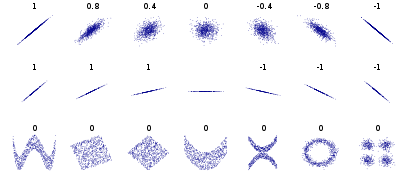
The caption below this image says:
[...] Note that the correlation reflects the non-linearity and direction of a linear relationship (top row), but not the slope of that relationship (middle), nor many aspects of nonlinear relationships (bottom). [...]
(bold text emphasis added by me)
The middle row of the picture shows several distributions that are perfectly correlated ($\rho=1$) and illustrates, that in that case the correlation coefficient does not change when the slope changes (apart from the case if either $x$ or $y$ is constant).
However, I have my doubts whether the correlation coefficient is really independent of the slope, when the correlation is not perfect (ie $\rho<1$). In other words, how does the correlation coefficient change, when I apply a simple rotation
$$ x'_i = x_i \cos(\alpha) + y_i \sin(\alpha) \\ y'_i = -x_i \sin(\alpha) + y_i \cos(\alpha) $$
to the data?
Note that the rotation does not change the mean values if $\sum x = \sum y = 0$, but even in the simple form as written above I didn't manage to derive an expression for
$$ \rho(\alpha) = ?? $$
yet. Or maybe I am just a bit confused and the correlation coefficient really does not change....

I suppose that $\sum_i x_i = \sum_i = y_i = 0$. Moreover, $P_x = \sum_i x_i^2$, $P_y = \sum_i y_i^2$ and $C_{xy} = \sum_i x_i y_i$.
Then, the sample Pearson coefficient $\rho$ based on data $x_i$ and $y_i$ produced by random variables $X$ and $Y$ is:
$$\rho = \frac{C_{xy}}{\sqrt{P_x P_y}}.$$
Notice that:
$$P_{x'} = \sum_i {x'}^2_i = \sum_i (x_i \cos \alpha + y_i \sin \alpha)^2 = \\ \cos^2 \alpha\sum_i x_i^2 + \sin^2 \alpha\sum_i y_i^2 + 2\sum_i x_i y_i \sin \alpha \cos \alpha = \\\cos^2 \alpha P_x + \sin^2 \alpha P_y + \sin(2\alpha) C_{xy},$$
$$P_{y'} = \sum_i {y'}^2_i = \sum_i (-x_i \sin \alpha + y_i \cos \alpha)^2 = \\ \sin^2 \alpha\sum_i x_i^2 + \cos^2 \alpha\sum_i y_i^2 - 2\sum_i x_i y_i \sin \alpha \cos \alpha = \\\sin^2 \alpha P_x + \cos^2 \alpha P_y - \sin(2\alpha) C_{xy},$$
and
$$C_{x'y'} = \sum_i x_i' y_i' = \sum_i (x_i\cos \alpha + y_i \sin \alpha)( -x_i \sin \alpha + y_i \cos \alpha) = \\ -\sum_i x_i^2\sin\alpha\cos \alpha + \sum_i x_i y_i (\cos^2 \alpha - \sin^2 \alpha) + \sum_i y_i^2\sin\alpha\cos \alpha = \\ \frac{1}{2}\sin(2\alpha)(P_y - P_x) + C_{xy} \cos(2\alpha).$$
Consider $\alpha = \frac{\pi}{2}$ and join all pieces togheter:
$$\rho' = \frac{C_{x'y'}}{\sqrt{P_{x'} P_{y'}}} = \frac{\frac{1}{2}\sin(2\frac{\pi}{2})(P_y - P_x) + C_{xy} \cos(2\frac{\pi}{2})}{\sqrt{(\cos^2 \frac{\pi}{2} P_x + \sin^2 \frac{\pi}{2} P_y + \sin(2\frac{\pi}{2}) C_{xy})(\sin^2 \frac{\pi}{2} P_x + \cos^2 \frac{\pi}{2} P_y - \sin(2\frac{\pi}{2}) C_{xy})}} = \\ = \frac{-C_{xy}}{\sqrt{P_yP_x}} = - \rho. $$
Conclusion: rotation affects Peason coefficient.
Addition
In general, the new Pearson coefficient, as a function of $\alpha$, is
$$\rho' = \frac{C_{x'y'}}{\sqrt{P_{x'} P_{y'}}} = \frac{\frac{1}{2}\sin(2\alpha)(P_y - P_x) + C_{xy} \cos(2\alpha)}{\sqrt{(\cos^2 \alpha P_x + \sin^2 \alpha P_y + \sin(2\alpha) C_{xy})(\sin^2 \alpha P_x + \cos^2 \alpha P_y - \sin(2\alpha) C_{xy})}}. $$