How much is $\lceil\frac{1}{\infty}\rceil$?

889 Views Asked by At

How much is $\lceil\frac{1}{\infty}\rceil$ ?

On one hand, $\frac{1}{\infty}=0$, so its ceiling is also $0$.

On the other hand, for all $x\geq 1$, $\lceil\frac{1}{x}\rceil = 1$, so, when $x$ goes to infinity, the function should remain with the same value...

6

There are 6 best solutions below

0
On BEST ANSWER

It's always dangerous to write $\infty$ in calculations. You have to be sure what you mean with writing $\infty$. In this case, you have two possibilities: $$\lim_{n\to\infty}\left\lceil \frac{1}{n} \right\rceil=1$$ or $$\left\lceil \lim_{n\to\infty} \frac{1}{n} \right\rceil=0.$$ You can not switch a function and a limit without further explanation. Compare with the important problem of the analysis where they try to switch a limit and an integral (the reason why the Lebesgue-integral is invented).

1
On

No, $\frac1\infty$ is not $0$: it is undefined. So, therefore, is $\left\lceil\frac1\infty\right\rceil$.

Your argument that it ought to be $1$ is also incorrect: it’s based on an unconscious assumption that the ceiling function is continuous. The same argument would say that since $1=\lim_{x\to 0^+}(x+1)$, and since $\lceil x+1\rceil\ge 2$ for all $x>0$, with $\lceil x+1\rceil=2$ for all small $x>0$, therefore $\lceil x+1\rceil$ ought to be $2$. But of course it isn’t: it’s $1$. The ceiling function isn’t continuous from the right at integers.

0
On

This is a great example of why we can't pass limits inside of non-continuous functions. Notice the following:

$$1=\lim_{n\to\infty}1=\lim_{n\to\infty}\left\lceil\frac{1}{n}\right\rceil\\0=\lceil 0\rceil=\left\lceil\lim_{n\to\infty}\frac{1}{n}\right\rceil$$

4
On

Great question! The main problem anyone's going to have answering it is that the fraction $\frac1\infty$ isn't defined: $\infty$ isn't part of the ordered field of real numbers, and you can't just divide $1$ by $\infty$. Moreover, the function $\lceil.\rceil$ is only usually defined on the real number line, so even in strange fields like the hyperreal numbers (I think), where things like $\frac1\infty$ do make sense, it's a lot harder to make sense of $\lceil\frac1\infty\rceil$.

Here's one way you might try to make sense of it. You say that $\frac1\infty=0$. In mathematics, we don't say that, but we do say that $\lim_{x\to\infty}\frac1x=0$. '$\lim_{x\to\infty}$' means that we consider the behaviour of $\frac1x$ as $x$ becomes arbitrarily large. As we make $x$ larger, $\frac1x$ gets closer and closer to $0$: in fact, we can make it as close to $0$ as we like by choosing $x$ large enough. So $\lim_{x\to\infty}\frac1x=0$. Therefore, $\lceil\lim_{x\to\infty}\frac1x\rceil=0$.

But we could also interpret $\lceil\frac1\infty\rceil$ as the mathematical expression $\lim_{x\to\infty}\lceil\frac1x\rceil$. Now we are considering the behaviour of $\lceil\frac1x\rceil$ as $x$ becomes arbitrarily large. This time, the behaviour is much simpler: as long as $x\ge1$, $\lceil\frac1x\rceil=1$. Therefore, $\lim_{x\to\infty}\lceil\frac1x\rceil=1$.

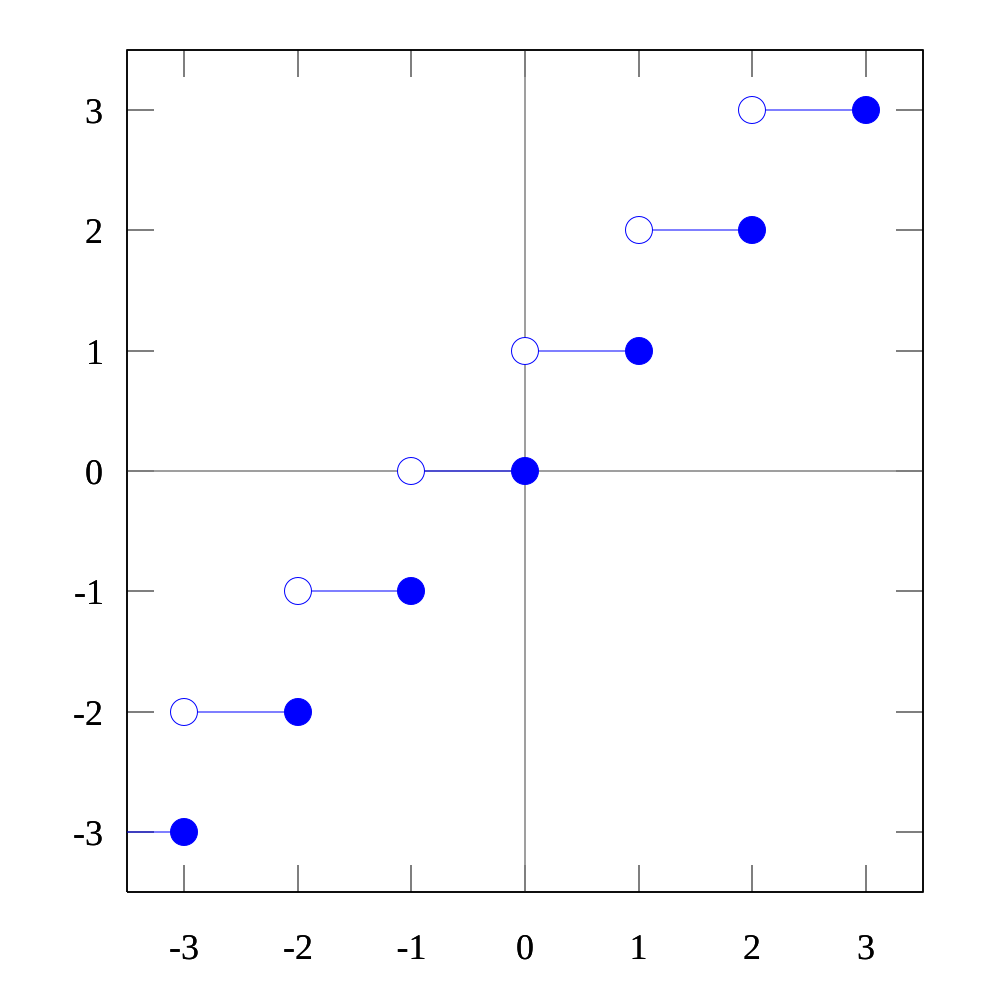
Because we can't swap the order of taking limits and taking the ceiling function, we say that the ceiling function $\lceil y\rceil$ is discontinuous at the point $y=0$. Discontinuity means that there is a 'jump' in the graph of the function: you can't draw it without taking your pen off the page:

Notice the 'jump' at the point $0$ in this graph of the ceiling function.

The opposite of 'discontinuous' is continuous. A function $f$ is continuous at a point $a$ if $f(a)=\lim_{x\to a}f(x)$. Functions which are continuous everywhere include all polynomials, and lots of other lovely functions like $\sin$, $\cos$ and the Bessel functions, but the ceiling function is discontinuous at $0$, which is why we can't give meaning to $\lceil\frac1\infty\rceil$.

0
On

To elaborate on the comment above by @Jonas Meyer, there are number systems extending $\mathbb{R}$ which contain infinite numbers. If the symbol "$\infty$" is interpreted as referring to such a positive number, then $\frac1\infty$ is a positive infinitesimal. In some of these number systems such as the hyperreals, there is a principle that allows one to extend functions to the larger number system. In particular, the floor and ceiling functions extend in this way, and one neccesarily has that $\lceil\frac1\infty\rceil$ is indeed 1.

0
On

$\frac{1}{\infty}=lim_{x\to\infty}\frac{1}{x}=lim_{x\to 0^+}x=0$ and ceil function is right discontinuous at $\mathbb{Z}$ especially at zero,now We have $\lceil\frac{1}{\infty}\rceil=0=\lceil\lim_{x\to 0^+}x\rceil\neq lim_{x\to 0^+}\lceil x\rceil=1$.