I'm a bit confused about how to normalize after the Gram Schmidt process from my textbook.
http://i33.photobucket.com/albums/d86/warnexus/length_zps0429d297.png
I understand that to calculate the length of a vector is 1) raise each component of the vector by two 2) add them to get a sum 3) take the square root of the sum.
Is the textbook getting the length by the three basis(which I enclosed in a blue rectangle in the image) or the three K's(k1,k2,k3)?
It seems like they are getting it from the three K's. But I do not know how the textbook got square root of 6 as the length.
For square root 3, they raise the components(1,1,1) by two and add which is three. Took the square root of 3 that is the length. I understand that.
I do not understand how they got the second one: the square root of 6 as the length. The textbook raise each of these components (-2/3,4/3,-2/3) by two. add them together and square root but I calculated square root of 24/9...
I understand how the textbook got third and final length. Raise these components (-1,0,1) by two. Add them and square root it which is square root of 2.
Am I seeing something wrong?

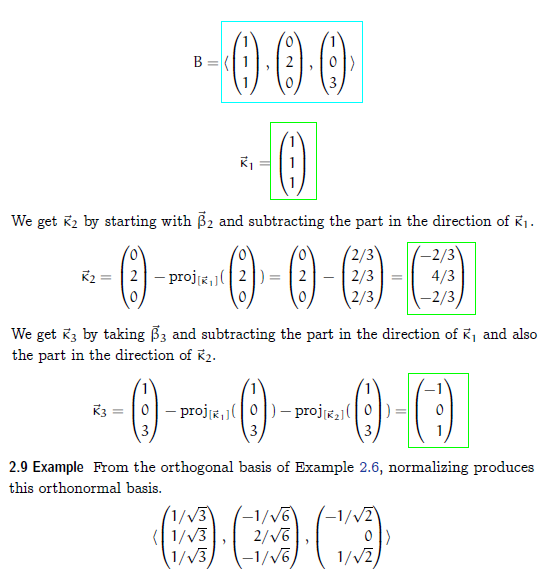
It gets the length by the three Ks, because you are trying to normalize each of the Ks... You are correct that the second one is the $\sqrt{\frac{24}{9}}$. Which is equal to $\frac{\sqrt{24}}{\sqrt{9}}$... Which is $\frac{\sqrt{24}}{3}$.... Remember that $\sqrt{(4)(6)} = \sqrt{4}\sqrt{6} = 2\sqrt{6}$.. Now try diving by the length and see what you get.