I am studying Lorentz transform and I do not quite get what it means to use the hyperbolic matrix to rotation a point on a hyperbola, mainly it is because the hyperbola consists of two divergent curves (with a huge space in between that nothing can jump across) and the curves don't bend the way that circles do.
If I were to draw the $0$ and $180^{\deg}$ radial plot on top of a hyperbola, where would they be?
Just to make it perfectly elucidating, if I were a red block lying on a curve of the hyperbola, what does it mean for me to rotate? Where would I be after rotation?


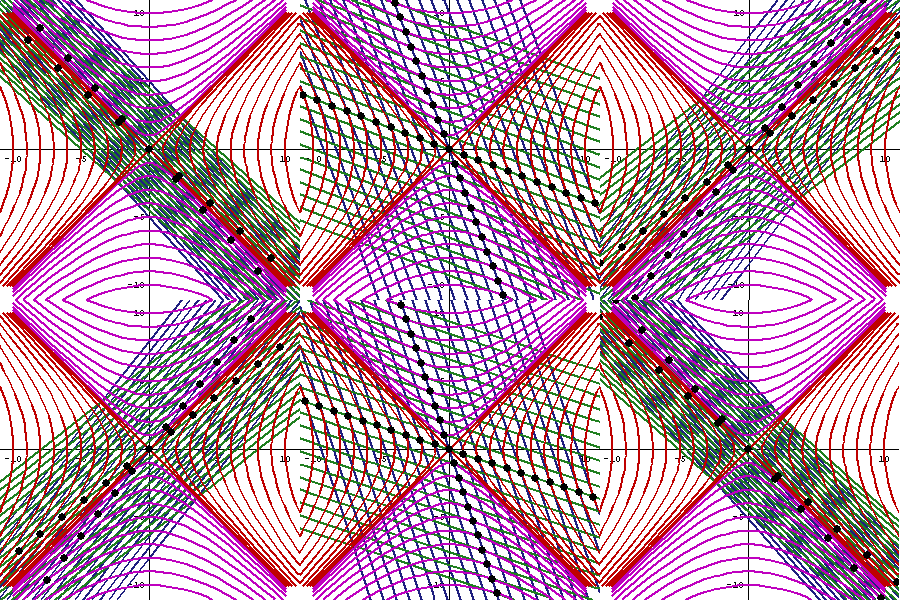
When we have a point on a sphere in Euclidean space this means it falls a certain distance from the center of the sphere. This distance is the radius and, assuming the center is the origin, we have $x^2+y^2+z^2=R^2$. If we rotate the point about the origin then it is still on the sphere.
In a similar way, if we take an event in space-time then it has a certain interval from the origin. Depending on what you read, either $-c^2t^2+x^2+y^2+z^2=I$ or $-I$. Let's suppose the signature is $(-1,1,1,1)$ for the Minkowski metric. Then, an operation which leaves the interval invariant is known as a Lorentz transformation. We can move the event around on the hyperboloid $-c^2t^2+x^2+y^2+z^2=I$ in space time by a Lorentz transformation. Suppose we drop $y,z$ and set $c=1$ then $-t^2+x^2=I$ is what is left. If we move the event to $t',x'$ where $$\left[ \begin{array}{c} t' \\ x' \end{array} \right] = \left[ \begin{array}{cc} \gamma & -\gamma \beta \\ -\gamma \beta & \gamma \end{array} \right]\left[ \begin{array}{c} t \\ x \end{array} \right] $$ where $\gamma = \cosh \phi$ and $\beta \gamma = \sinh \phi$ then \begin{align} -(t')^2+(x')^2 &= -(\gamma t-\gamma \beta x)^2+(-\gamma \beta t+\gamma x)^2 \\ &= \gamma^2\left(-t^2+2\beta xt-\beta^2x^2+\beta^2 t^2-2\beta xt + x^2\right) \\ &= \gamma^2 (1-\beta^2) \left( -t^2 +x^2 \right) \end{align} But, $\gamma^2-\beta^2 \gamma^2 = \cosh^2 \phi - \sinh^2 \phi = 1$ hence $$ -(t')^2+(x')^2 = -t^2+x^2 $$ I wouldn't recommend a direct visualization. But, perhaps the analogy to rotations in three dimensions is helpful. The concept here is that the event in space time is geometric, but the coordinates $t,x,y,z$ are merely based on the artificial choice of a reference frame. Einstein told us, the laws of physics should be independent of that choice (at least he told us this in 1905, maybe the story changes in 1916). The reason for these weird Lorentz transformations is that they are necessary for us to keep the speed of light invariant under these mixing transformations between space and time.