I am having difficulties understanding and solving the following problem.
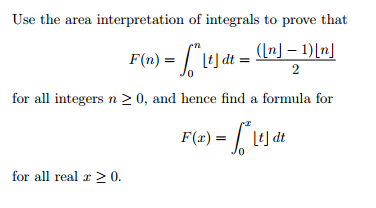
So far I think I understand the first line. I know what the graph of floor[t] looks like and I understand they're asking to integrate from 0 to some value of n and that integral always equals the equation on the right. I do not really understand what they are asking for in the second line or how that differs from the first equation.
I have checked through my notes and various online sources and we've just covered the fundamental theorem of calculus and discussed integration using partitions on an interval to calculate area but I am also unsure about how to relate these to this problem if they are even needed.
Any pointers, explanations or solutions would be greatly appreciated.
Thank you.

What they want you to do is extend the same function beyond an integer domain, so if $k = \lfloor x \rfloor $ $$\int_0^x\lfloor t\rfloor\ dt = \int_0^k\lfloor t\rfloor\ dt +\int_k^x\lfloor t\rfloor\ dt=\frac{(k-1)(k)}{2} + \cdots$$
EDIT:
Let's take a closer look at $\int_k^x \lfloor t \rfloor \ dt$.
Recall that $k = \lfloor x \rfloor$, and since this is the closest integer value less than $x$, we know a few things.
Because of this, we know that if $t$ between $k$ and $x$, $\lfloor t\rfloor = k$, for all $t$ in that interval.
Because of this, we are integrating a constant between $k$ and $x$, so the area of that region would be a rectangle with length $(x-k)$ and height $k$.