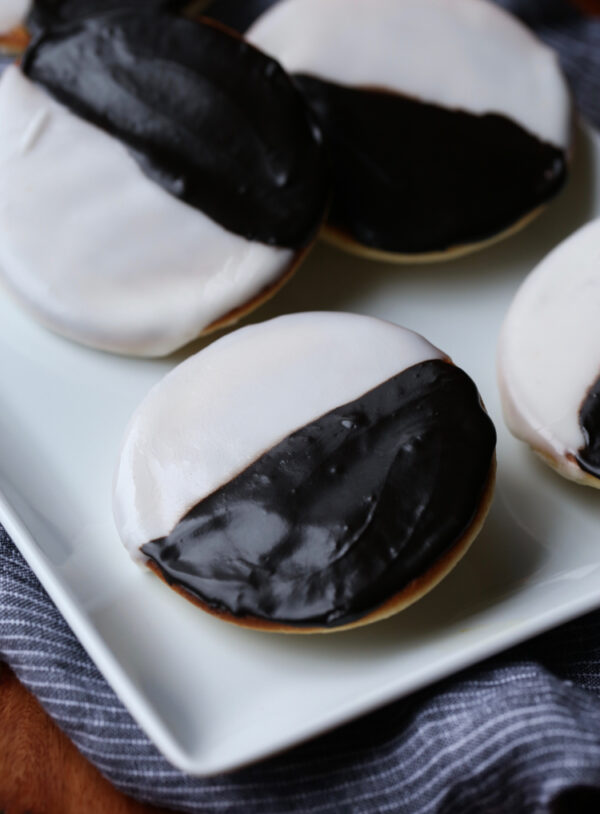
This problem came from trying to divide a black and white cookie into 3 equal parts where each part has some of the white and some of the black.
It's easy enough to get one or two pieces with both parts using the standard 120 degree wedges, but those wedges can never get pieces with both black and white on all three pieces.
If you try to divide with parallel lines, using some geometry you get that you can use chords with an angle $$\frac{2 \pi}{3}=\theta - \sin(\theta)$$
So my question is: do we know anything about the properties of $\theta$? Ideally what I would like to know is whether it is constructible as an angle. My guess would be no but I haven't figured out how to show it or found anything about this anywhere else online. Thanks!

My guess is that isn't constructable. If you could combine arclengths with line segment lengths with a straightedge and compass, squaring the circle wouldn't be an impossible problem.
To answer your broader question...