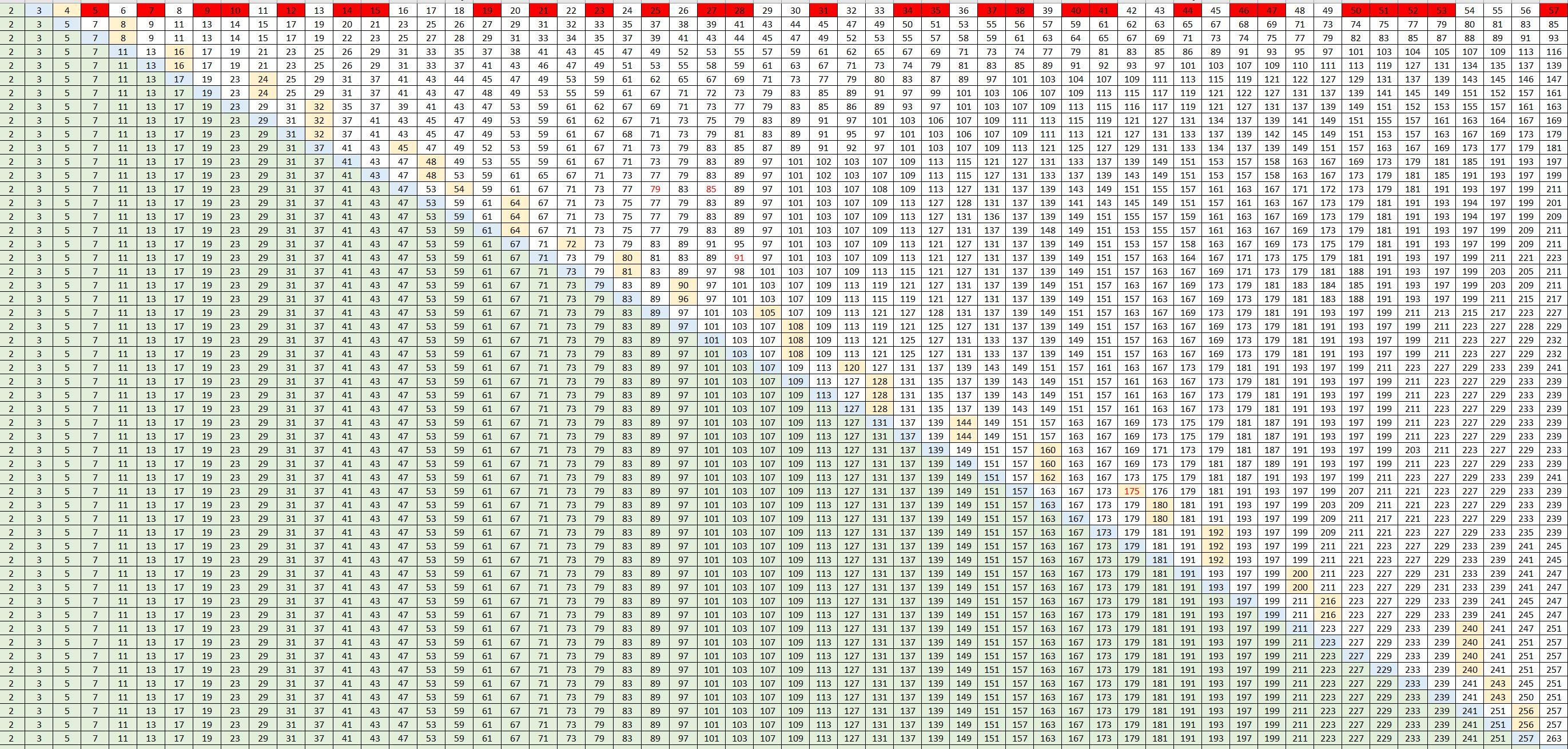
Please see the following definition of an array A(n,k):
a(n,1)=2; every k+1 consecutive terms in each row are coprimes.
For example, the first row, every 2 consecutive terms are coprimes. That gives us the natural numbers (except 1.)
In the second row, each 3 consecutive terms are coprimes.
In the third row, each 4 consecutive numbers are coprimes.
And so on.
Prime numbers move to the left with each step. The second diagonal (and all the numbers to the left) are all primes (let’s call it the Primes Diagonal.)
This array gives us many sequences including:
The array itself (red by antidiagonal):
2, 3, 2, 4, 3, 2, 5, 5, 3, 2, 6, 7, 5, 3, 2, 7, 8, 7, 5, 3, 2, 8, 9, 8, 7, 5, 3, 2, 9, 11, 9, 11, 7, 5, 3, 2,…..
The first composite number in each row:
4,8,8,16,16,24,24,32,32,32,45,48,48,54,64,64,64,72,80,81,90,96,105,108,108,120,128,128,128,…..
I called the numbers above "barriers" because they separate prime numbers (on the left) from the rest of row.
Some columns don’t have any "barriers":
4,6,8,9,11,13,14,18,20,22,24,26,27,30,33,34,36,37,……
Powers of 2 (4,8,16,32,…) are always "barriers." And in their last appearance they become in touch directly with second diagonal. Other "barriers" don’t do this. There is always a prime number between a regular barrier (like 24,45,48,..) and the Primes Diagonal. The last appearance of the power of 2 is at (n,n+2.) For example, 64’s last appearance is at (17,19.) Another different thing about this sieve is that some numbers disappear then reappear. For example, 26 disappears on the third row, then reappears on the 4th and 5th rows, then disappears forever. Maybe these numbers deserve a sequence on their own. This sieve seems promising when it comes to counting the number of primes smaller than n, or at least the number of primes smaller than a power of 2.
This is a screen shot of the array. https://justpaste.it/img/d2a04fba334538242102f31004891c38.jpg