There are three piles of coins. You are allowed to move coins from one pile to another, but only if the number of coins in the destination pile is doubled. For example, if the first pile has 6 coins and the second pile has 4 coins, then you may move 4 coins from the first pile to the second pile — no more or less. Prove that by repeating moves of this sort, it is possible to empty one of the piles.
Despite my best efforts, I have been unable to find a general solution strategy. Any pointers would be much appreciated.
Background: A special case of the puzzle appeared in The Moscow Puzzles: 359 Mathematical Recreations.
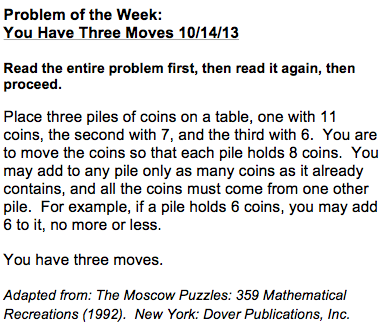
Starting with piles $(11,7,6)$, can you move coins (as specified above) so that you have piles $(8,8,8)$?
Yes, $(11,7,6)\to(4,14,6)\to(4,8,12)\to(8,8,8)$ works.

The solution is detailed in this paper by Peter Winkler: http://math.dartmouth.edu/~pw/papers/algor.ps