In 1974, a paper titled On the Classification of Knots by Ken Perko appeared showing that the knots $10_{161}$ and $10_{162}$ in Dale Rolfsen's knot table were actually the same knot. He included this picture, showing how to deform one into the other:

Edit: A clearer, color-coded version
From that point on, $10_{161}$ and $10_{162}$ became known as the Perko pair, or the Perko knot.
Another view of the pair can be found on the KnotPlot website. That link shows its own explicit deformation between $10_{161}$ and $10_{162}$, and its pair looks like this:
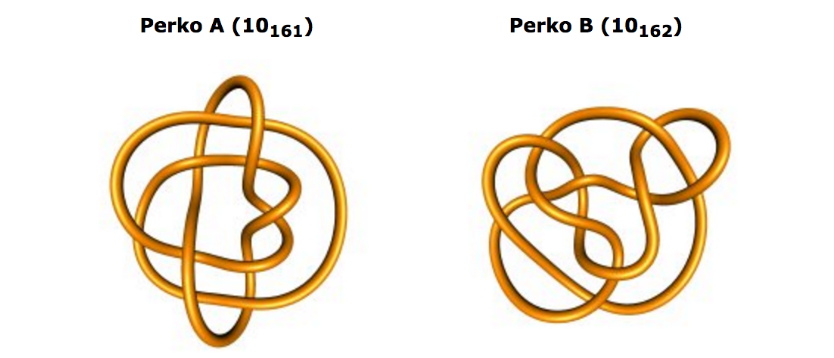
Wikipedia also has pictures of the pair (click here or here for bigger images):

Here's a version that Perko himself drew (redrawn by me):

There's a problem, though. I mean, for one thing, these all kinda look nothing like each other. But a bigger problem is this: the Perko knot is chiral! That is, there's a left-handed and right-handed version.
I've drawn my own projection of the Perko knot:

and I'm fairly certain that the one that I drew matches the handedness found in the original paper, as well as the KnotPlot one. However, Wikipedia's first image (the one of $10_{161}$) seems to be a mirror version.
So, my question is this:
Call the one that I drew the left-handed Perko knot, and its mirror image the right-handed Perko knot. What is the handedness of Wikipedia's second image? What are the handednesses of the ones that Perko drew? And am I right in saying that the paper's image and KnotPlot's image are both left-handed, and that Wikipedia's first image is right-handed?


The diagrams in On the Classification of Knots are left-handed.
The pictures from KnotPlot are left-handed.
Wikipedia's pictures are right-handed.
The first of Perko's drawings is right-handed; the second is left-handed.
I determined this experimentally by tying the knots in my headphones and manipulating them until I got them into a form I recognized. I didn't compute the Jones polynomials, since that would probably take around an hour per knot.
This was much harder than I thought it would be. I thought that a physical knot would naturally end up in the configuration of "lowest energy" (whatever that means) when the ends are pulled, but it turns out that knots are much more annoying than that.
I have a lot of respect for the early knot theorists who made knot tables before anyone knew how to rigorously prove that any two knots were distinct. And I don't blame them for thinking the Perko pair was two distinct knots.
Here's the (left-handed) Perko knot tied in my headphones: https://i.stack.imgur.com/uMFvE.jpg