I've been going through Rudin's Real and Complex Analysis (3rd edition) but I got somehow stuck at the proof of Mittag-Lefler theorem (Theorem 13.10, page 273). The problem is I can't see why Theorem 13.6 implies existence of the function $R_n$ with all poles outside $\Omega$ (right before the inequality $(2)$). I could of course apply Theorem 13.6 to $K_{n-1}$ but in that case I would only know that $R_n$ has all poles outside $K_{n-1}$ not necessary outside whole $\Omega$.
It's probably something trivial but I don't get it... Thanks a lot for any help!
Theorem 13.6:
Suppose $K$ is a compact set in the plane and $\left\{\alpha_j\right\}$ is a set which contains one point in each component of $S^2\setminus K$. If $\Omega$ is open, $K\subseteq\Omega$, $f\in H\left(\Omega\right)$ , and $\epsilon > 0$, there exists a rational function $R$, all of whose poles lie in the prescribed set $\left\{\alpha_j\right\}$, such that $$\left|f(z) - R(z)\right| < \epsilon$$ for every $z\in K$.
Page 273
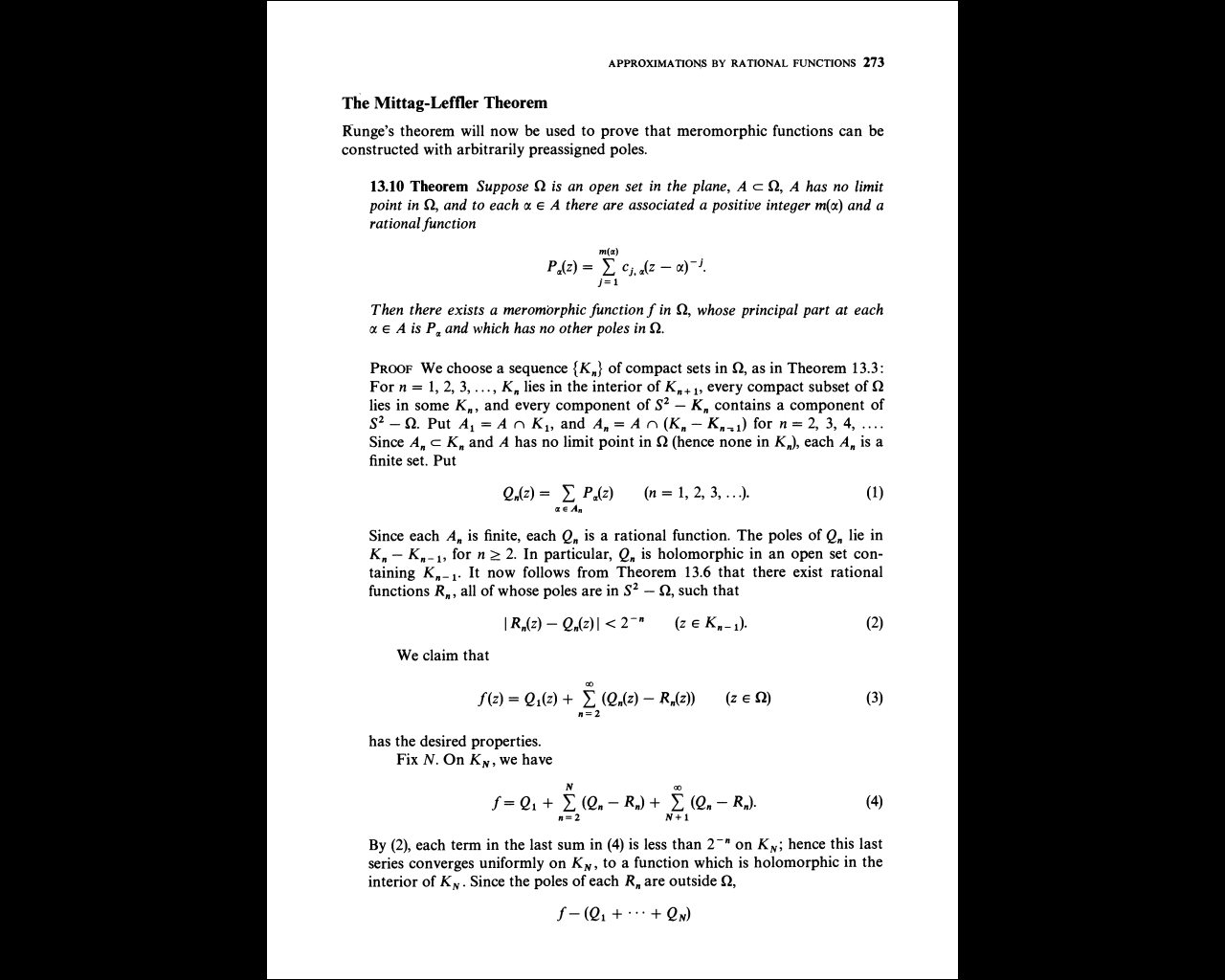

I think the key information is in the sentence
(Geometrically/topologically, this is just saying that "$K_n$ does not have any unnecessary holes".)
This way, whenever one needs to prescribe a pole $\alpha$ in a component of $\mathbb{S}\setminus K_{n-1}$ (as in Th 13.6), one can actually pick the pole to be inside $\mathbb{S}\setminus \Omega$. It follows that all the poles are outside $\Omega$.