I am reading about the $\dot{C^2}$ norm but I am not entirely sure. It is defined by:
$$ \big|\big|\ f \,\big|\big|_{\dot{C^2}} = \sup_{x \in \mathbb{R}} |f''(x)| $$
I have heard of the $L^1$ and $L^\infty$ norms (the last one is the sup of $f(x)$ for $x \in \mathbb{R}$ but is this norm the same as $\dot{C^2}$ defined about. The axioms of the normed vector space are as follows:
The zero vector 0 has "length" zero and nothing else. All other vectors $||\vec{v}||> 0$ have positive norm.
Multiplying a vector by a scalar $a \in \mathbb{R}$ multiplies the length by that constant $ ||a \vec{v}|| = a ||\vec{v}||$
Normas satisfy the triangle inequality -- $|| \vec{v}|| + ||\vec{w}|| \geq || \vec{v}+ \vec{w}|| $
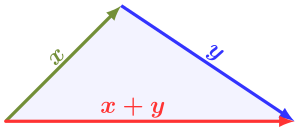
Is it obvious that triangle inequality holds for the operation I have defined above? Or anything else for that matter? Here $f$ is smooth so I have ruled out nice functions like:
$$ f(x) = \left\{ \begin{array}{cc} 0 & \text{ if }x < 0 \\ 1 & \text{ if }x \geq 0 \end{array} \right.$$
or the absolute value function $f(x) = |x|$.