Can someone provide a link to a proof or motivate here (not looking for a rigorous proof) of a very important result in complex analysis, particularly in applications to control systems engineering:
Given a rational (transfer function) polynomial, $G(s)$, of a complex variable $s=\sigma+i\omega$ the closed contour shown here
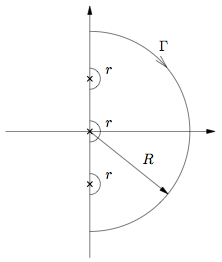
is mapped by $G$. The "x's" represent poles (singularities of $G$). The large ($R \to \infty$) semicircle of $\Gamma$ is mapped to the origin, the part of $\Gamma$ on the imaginary axis is mapped according to our knowledge of $G$, and finally the small semicircles ($r \to 0$) on the imaginary axis are mapped to circular arcs of angle $m\pi$ where $m$ is the multiplicity of the pole in question.
It is this last part that I really need help motivating (the part about multiplicity)! I also understand that since mapping is conformal, the right angled turns encountered at the indentations should also map to right angled turns in the mapped domain. Also if someone knows the analog to discrete time that would be a plus.

Let
$$G(s) = \frac{(s-z_1) \dots (s-z_m)}{(s-p_1) \dots (s-p_n)} = \frac{\prod_{i=1}^m |s-z_i|}{\prod_{i=1}^n |s-p_i|} \exp \left(i \left(\sum_{i=1}^m \angle(s-z_i)-\sum_{i=1}^n \angle(s-p_i)\right) \right)$$
Now when $\Gamma$ semi-encircles a pole (the small $r$) the phase difference would be $\pi$ radians. Multiplicity comes from the above summation. If $k$ poles are semi-encircled at the same time the phase difference would be the sum of each of them, i.e. $k \pi$.
The principle is the same for discrete time, but you need to select the path on unit circle.