I know the vertex figures are icosahedra, so every vertex is contained in 12 edges. I can also verify it mathematically, my question is about the visualisation.
I cannot see 12 edges on a vertex here: https://upload.wikimedia.org/wikipedia/commons/c/c3/Schlegel_wireframe_600-cell_vertex-centered.png
If someone could either highlight on a picture edges departing from a vertex or tell me what I am missing that would be great.

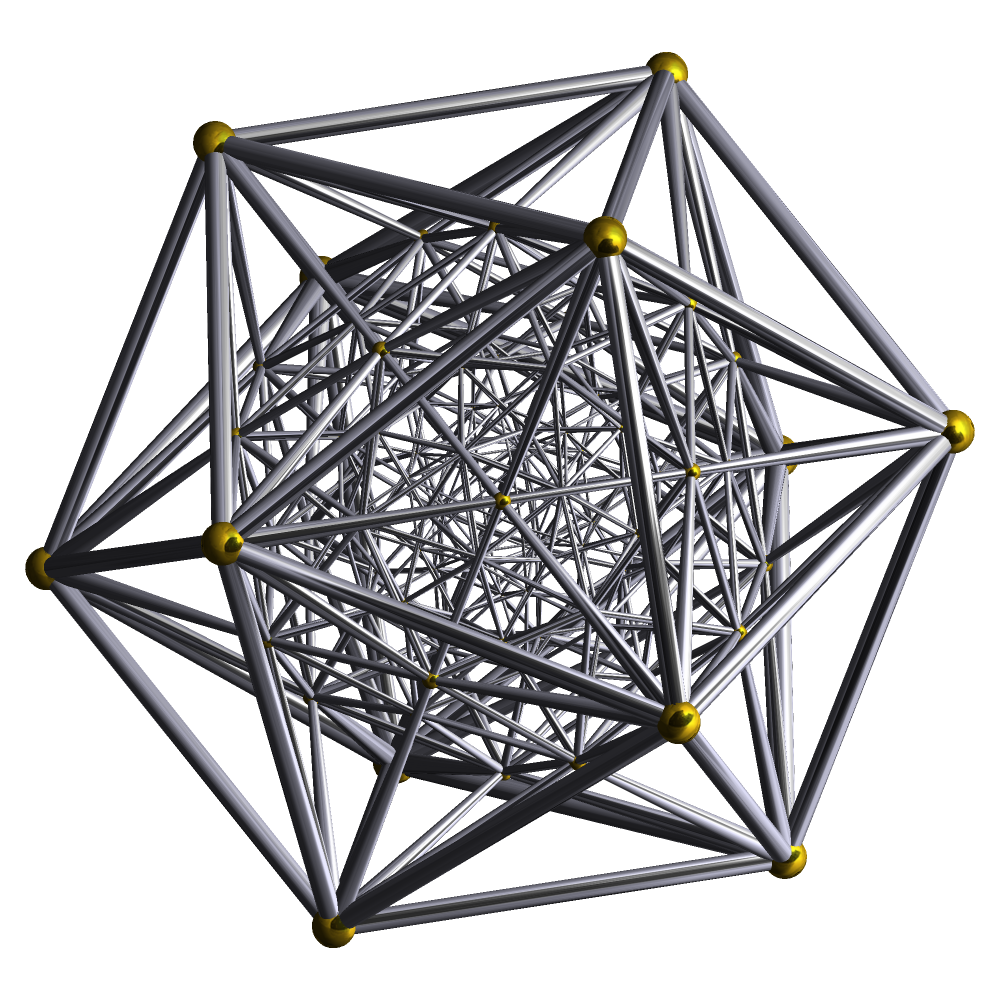
After searching for good images of the $600$-cell on-line and in my copy of Coxeter's Regular Polytopes, and considering my own experience visualizing the $600$-cell, I am not sure there are any extant visualizations of the entire $600$-cell that can one could use to verify the number of edges at every vertex.
A Schlegel diagram, as I understand it, should be a perspective projection of a polytope embedded in $\mathbb R^n$ to one embedded in $\mathbb R^{n-1}$ from a point outside the polytope but near the center of one of the polytope's facets. In this way the entire projection exactly occupies a polytope in the form of one facet of the larger polytope. This is in fact the projection of the facet whose center is near the center of projection, and it is filled by the projections of all the other facets. Hence the Schlegel diagram of the cube is a square subdivided into quadrilaterals; the Schlegel diagram of the regular dodecahedron is a regular pentagon subdivided into pentagons; the Schlegel diagram of the tesseract is a cube subdivided into (mostly distorted) cubes; the Schlegel diagram of the $120$-cell is a regular dodecahedron subdivided into (mostly irregular) pentagonal dodecahedra; and so forth. And indeed you can find Schlegel diagrams of this kind on Wikipedia for all of the regular polyhedra, for the pentachoron, the tesseract, the $16$-cell, the $24$-cell, and the $120$-cell.
The Schlegel diagram of the $600$-cell should be as described by Sommerville, quoted from a presentation by George W. Hart:
What we find instead on Wikipedia is a regular icosahedron subdivided into tetrahedra, hence not a Schlegel diagram as I understand it. I believe it is not even a complete projection of a $600$-cell; I think it is a projection of a $600$-cell with one vertex and all the edges and facets around that vertex deleted, projected through a point at or near the missing vertex.
The further projection of this three-dimensional diagram onto two dimensions has the additional disadvantage that several vertices are directly behind the vertex shown in the center, and many edges are obscured by other edges.
The closest thing to a Schegel diagram of the $600$-cell that I have found is this figure created by Jenn3D:
This diagram is the result of projecting the $600$-cell onto its circumhypersphere (replacing the edges with curved segments) and then projecting that figure stereographically onto three dimensions.
I can clearly count $12$ edges coming out of the leftmost vertex in this figure, but at all other vertices there are edges completely obscured by others or the edges are just too small to make out. But judging from some of the screen shots given on the Jenn3D web site, it may be possible to navigate your way through the projection in order to view other vertices better.
There are also orthogonal projections into 3D (and then into 2D) at Wolfram MathWorld (with an animated rotating projection) and on Plates IV and VII of Coxeter, but I find these not much use except to get a sense of just how complex the $600$-cell is.
There are two projections by SageMath that you can rotate and zoom. The rotation only affects the orientation of the three-dimensional projection on your display, not the projection itself. There are two projections; the one on the left is like the Wikipedia projection, but the one on the right appears to be almost a Schlegel diagram, although possibly projected from too far away for everything to fit inside the projection of the nearby cell. I was able to count $12$ edges coming out of an outermost vertex on the right-hand figure by rotating it.
Another interesting exercise would be to build a 3D project in in Zome. There is a web page devoted to this, but it would take a lot of Zome pieces to finish it. I completed just part of a similar model a few years ago before I ran out of parts.