Suppose $\Lambda$ is a lattice in $\Bbb R^2$. One way to represent this lattice is as a set of generating vectors $v_1$ and $v_2$. However, this is a non-unique representation, as multiple vectors generate the set.
A better way to uniquely represent $\Lambda$ is to instead treat it as a lattice in $\Bbb C$ rather than in $\Bbb R^2$. We can then uniquely represent the lattice using the two Eisenstein series $G_4$ and $G_6$:
$$ G_{2k}(\Lambda) = \sum_{0 \neq \omega \in \Lambda} \frac{1}{\omega^{2k}} $$
Since we are now treating the lattice vectors as complex numbers in $\Bbb C$ rather than vectors in $\Bbb R^2$, the above will converge to a complex number. It is then known that for any lattice $\Lambda$, the pair $(G_4(\Lambda), G_6(\Lambda))$ then uniquely represents the lattice. That is, we have that the map
$$ \text{lattices} \to \Bbb C^2 \\ \Lambda \mapsto (G_4(\Lambda), G_6(\Lambda)) $$
is a bijection (including degenerate lattices). There are many descriptions of the above online: The Space of Lattices, Lorenz and modular flows: a visual introduction, n-Category Cafe: The Modular Flow on the Space of Lattices, etc. Serre’s A Course in Arithmetic, p. 89 is often cited.
My question is: How can you do something similar for the space of lattices in $\Bbb R^3$, or $\Bbb R^n$ in general? To get the Eisenstein series, we had to treat $\Bbb R^2$ as an algebra, so that we could take powers of vectors. Is there a different algebra, perhaps a Clifford algebra, that we can use on $\Bbb R^n$ to define a higher-dimensional analogue of the Eisenstein series?
The reason I ask is that this representation is very natural. The axis with $(G_4(\Lambda), G_6(\Lambda)) = (1,0)$ represents the square lattice with 4-fold symmetry, and the axis with $(G_4(\Lambda), G_6(\Lambda)) = (0,1)$ represents the triangular lattice with 6-fold symmetry. So, we basically represent the space of lattices as a "direct sum" of the spaces of rotated square and triangular lattices. We can easily see that the topology of the unimodular lattices is that of the 3-sphere, except for a trefoil knot representing the degenerate lattices. There are various Seifert fibrations representing modular flow (image) and so on.
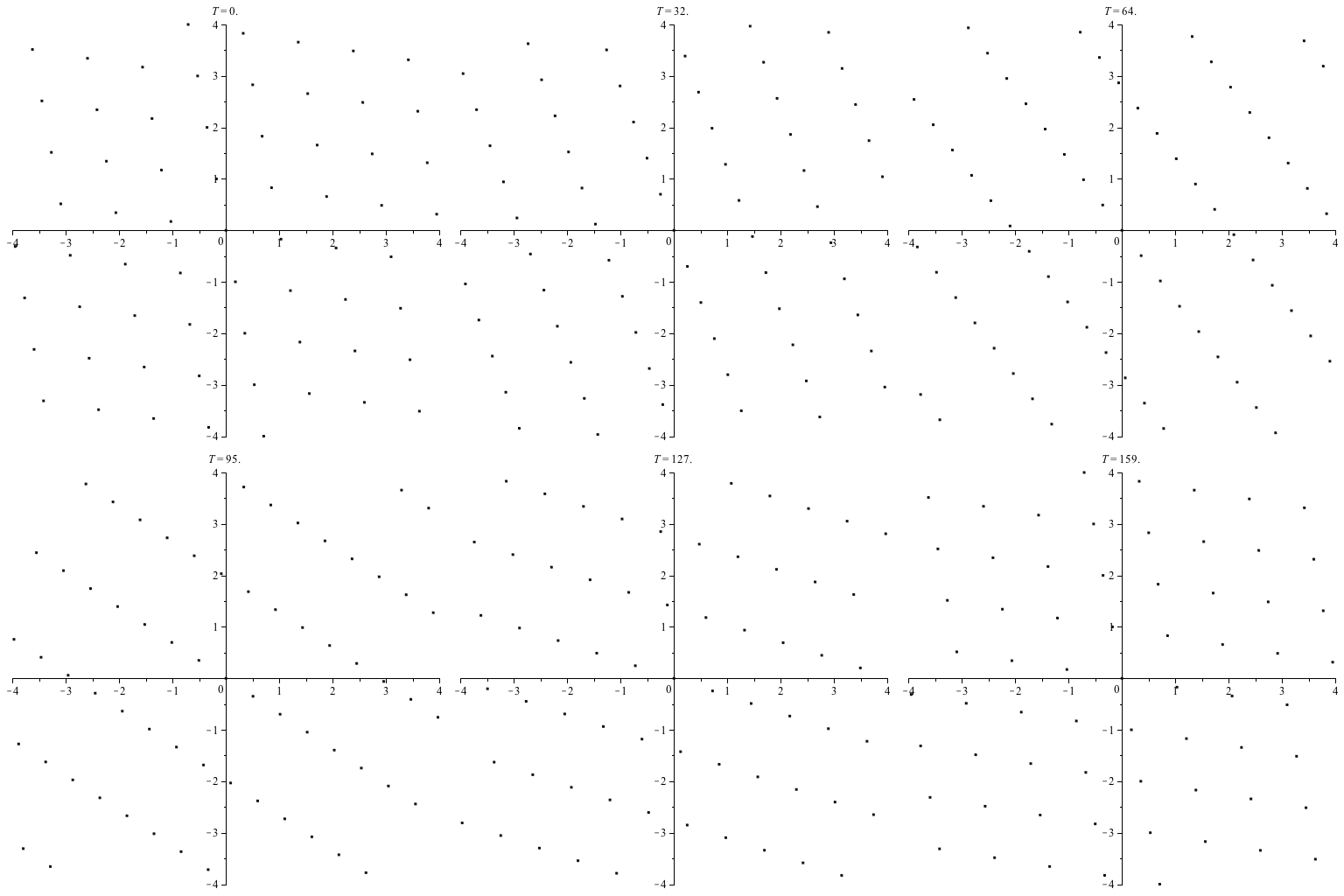
The thing is that we got all this great structure only because we "cheated" and decided that $\Bbb R^2$ was isomorphic to $\Bbb C$. Phrased another way, all this structure resulted from us placing this nontrivial algebra structure on $\Bbb R^2$ from which we got the Eisenstein series. Doing so, however, gave us a very natural representation of the space of lattices. So it seems there should be a similar representation of the space of lattices in $\Bbb R^n$.