Volume of revolution setup

45 Views Asked by At

I've been given a question as so

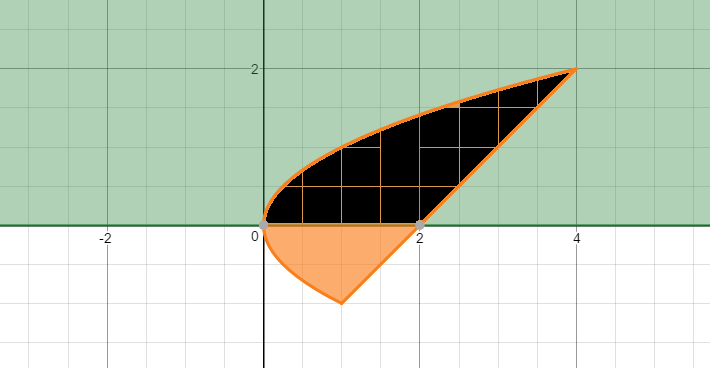
Consider the region $R = \{(x,y)\; |\; 0 ≤ y \;and \;y^2≤ x ≤ y+2\}$

Draw R and calculate the exact volume by rotating the region R about the line x=0

So this is what $R$ looks like (shaded in black).. I think.

And the equation I came up with was to integrate from 0 to 2, of the equation $π((y+2)-y^2)^2 \;dy$

Is this correct? I've never attempted a question setup like this before.

Thank you so much!

2

There are 2 best solutions below

2
On BEST ANSWER

Close. Just remember that: $$ \pi(R - r)^2 \neq \pi(R^2 - r^2) $$

So the correct setup is: $$ V = \pi\int_0^2 \left[(y + 2)^2 - (y^2)^2 \right] \, dy $$

0
On

Using the second Guldinos theorem, see https://en.wikipedia.org/wiki/Guldinus_theorem, the volume of the region is $V=Ad$, where $A$ is the area of the plane figure that generates the solid of revolution, in your case $A$ is $R$, and $d$ is the distance traveled by its centroid. So, the solution would be $V= 2\pi \bar{x}\,m(R)$ where $m(R)= \iint_{R} \, dxdy =\int_{0}^{2}\left (\int_{y^2}^{y+2} dx \right )dy=\int_{0}^{2} (y+2-y^2) \, dy=\frac{10}{3}$, $\bar{x}$ is the distance between the axis and the centroid: $$ \bar{x}=\frac{\iint_{R} x \,dxdy}{m(R)}=\frac{1}{m(R)} \int_{0}^{2} \int_{y^2}^{y+2} x \, dxdy=\frac{46}{25} $$ then $V=2\pi \frac{46}{25} \frac{10}{3}=\frac{184}{15}\pi$