wedge product of $m$ vectors in $\mathbb{R}^n$

1.4k Views Asked by At

I came across the symbol $|v_1 \wedge \dots \wedge v_m|^{-1}$ in a paper - this is the norm of the wedge product of vectors $v_k \in \mathbb{R}^n$ . I thought it's meaning was self-evident until I tried to compute it.

First of all $|v_1 \wedge \dots \wedge v_m|$ is a number since we are taking the reciprocal.

If there were $m = n$ vectors then $|v_1 \wedge \dots \wedge v_n| = \det (v_i \cdot v_j) $ and it is the volume of the paralleliped generated by the vectors $v_1, \dots, v_n$.
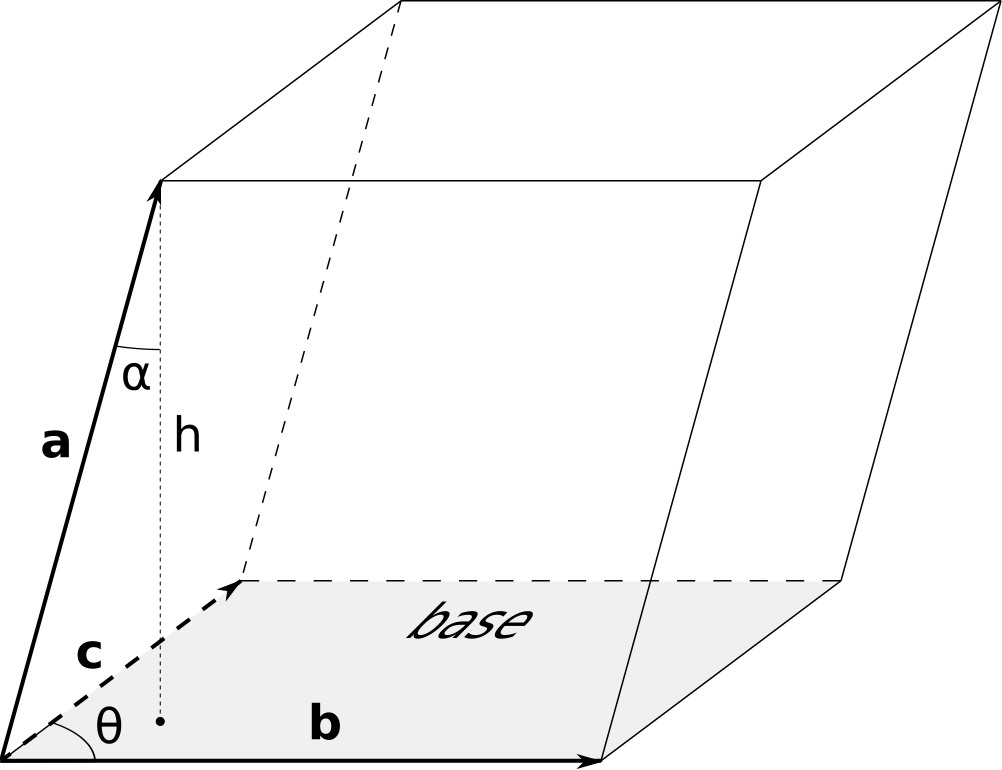
If we have $m < n$ vectors, given in coordinates, we have the volume of the $m$-dimensional parallelipiped inside of $n$-dimensional space. This volume is 0 unless we use the $m$-dimensional volume measure.

In exterior algebra, if I have the coordinates of the vectors, $v_1, \dots, v_m$, how do I compute this volume?

2

There are 2 best solutions below

1
On

Write each $v_k$ as a column vector. The $m$-volume is the square root of the sum of the squares of the $m \times m$ minor determinants of the matrix $[v_1 | v_2 | \cdots | v_m]$.

0
On

In clifford algebra, this could be easily computed. A wedge product of $m$ linearly independent vectors can be rewritten as a geometric product of $m$ orthogonal vectors $u_1 u_2 \ldots u_m$. The product of this $m$-vector with its reverse $u_m u_{m-1} \ldots u_2 u_1$ is guaranteed to be a scalar; call this $|v_1 \wedge v_2 \wedge \ldots \wedge v_m|^2$.

If you would rather not use clifford algebra, then you can think of the metric as having a natural extension to $k$-vectors. For instance, can you identify what $g(e_1 \wedge e_2 , e_1 \wedge e_2)$ should be? How about $g(e_1 \wedge e_2, e_1 \wedge e_3)$?

You could then expand $V = v_1 \wedge v_2 \wedge \ldots \wedge v_m$ in terms of the basis $m$-vectors, and since you know how the metric acts on these basis $m$-vectors (it's very simple for any orthonormal basis), you can compute the norm. Realistically, if this is Euclidean space with an orthonormal basis, then the metric will just tell you to take the sum of the squares of the components.