I was talking with a friend last night about covering spaces. My understanding is that a covering space is a way of simplifying the fundamental group of your space as the fundamental group of your covering space is a subgroup of the fundamental group of your space.
For example the fundamental group of $S^1$ is $\Bbb Z$ and a covering space of $S^1$ is $\Bbb R$ which has trivial fundamental group. This is an example of a normal covering. I.e. a covering whose fundamental group is a normal subgroup.
This is nice algebraically, so it makes sense to study this. However we were unsure of what a normal covering looks like/means geometrically.
So:
What does a normal covering mean geometrically?

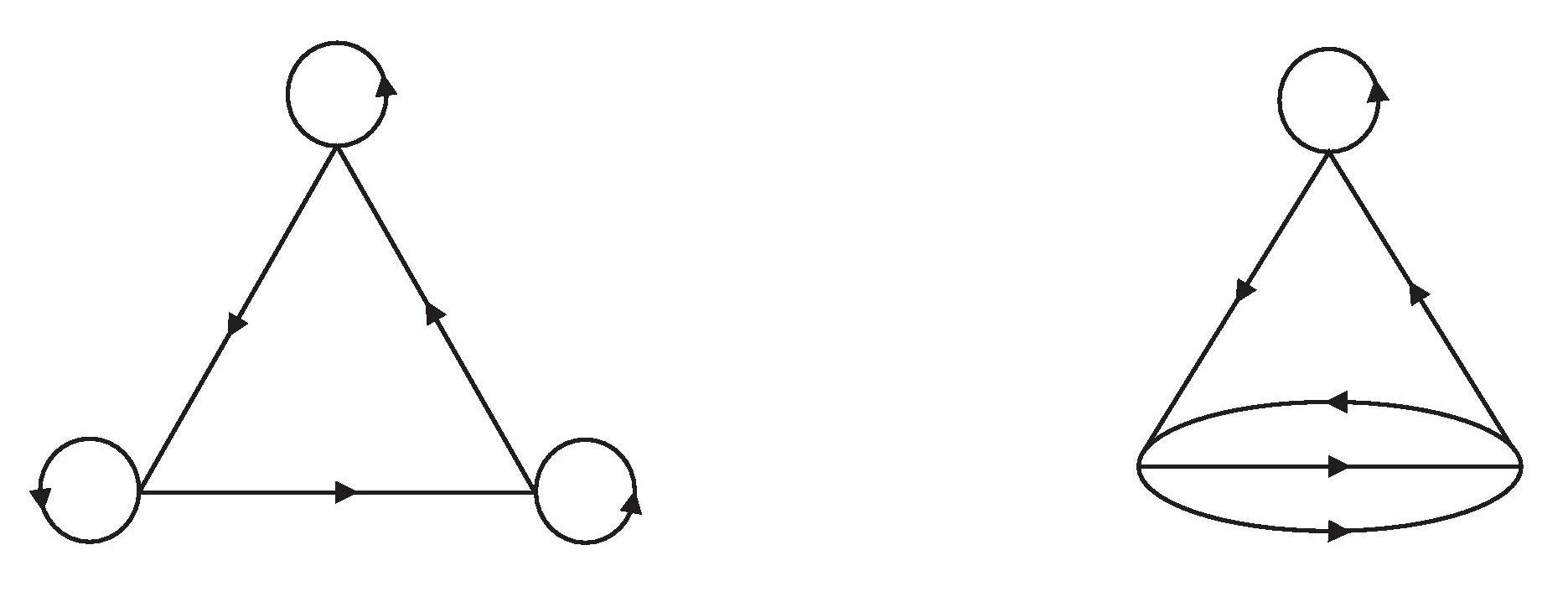
It's interesting to see an example where the covering is not normal to see what happens geometrically; and they're not se easy to find.
Indeed we first have to find an example of a space with nonabelian fundamental group, and they're not easy to find when you're beginning homotopy theory. Such an example could be $S^1\lor S^1$. Its fundamental group is $\mathbb{Z}*\mathbb{Z}$, the free product. In this case, the first copy of $\mathbb{Z}$ is not normal, and a bit of covering theory tells us that there should be a covering space with this as a fundamental group, and some more covering theory tells us what it looks like.
Start with the universal covering, which is a sort of tree, with many copies of $\mathbb{R}$, tied together at integer nodes. If you know what this means, this is the Cayley graph of $\mathbb{Z}*\mathbb{Z}$ with the standard generators. Then quotient out by the action of said first copy of $\mathbb{Z}$ on the tree. What you get is a bit hard to visualize (to me at least it is), but essentially you get is tons of branches with tiny loops attached to them at integer nodes. Now what happens is that if you look at one of those tiny loops, you have two ways to go down to a node below : the one that goes down the line that was attached to what used to be the starting point of the loop, and the one that goes down the line that was attched to what used to be the ending point of the loop. Here if you can make a drawing for yourself that would probably help a little.
These two ways of going down a node yield two drastically different ways of lifting the loop that goes around each circle in $S^1\lor S^1$. One of these is to go up, then around the tiny loop, then down the same way we got up.
The other one consists in going up, then around the tiny loop, then going down with the second way that I described earlier. These two lifts are drastically different, in that one of them is a loop, and the other one isn't.
And it turns out that this is a characterization of normal coverings if your spaces are nice enough : a covering is normal if and only if whenever $\gamma$ is a loop in the base space, and $\alpha,\beta$ are two lifts to the total space, then either both $\alpha, \beta$ are loops, or neither is.
There are other ways to see this geometrically, but perhaps start with this one to try and understand what's happening (and if you know some more nonnormal coverings, try to find loops $\gamma$ such that the above characterization fails)