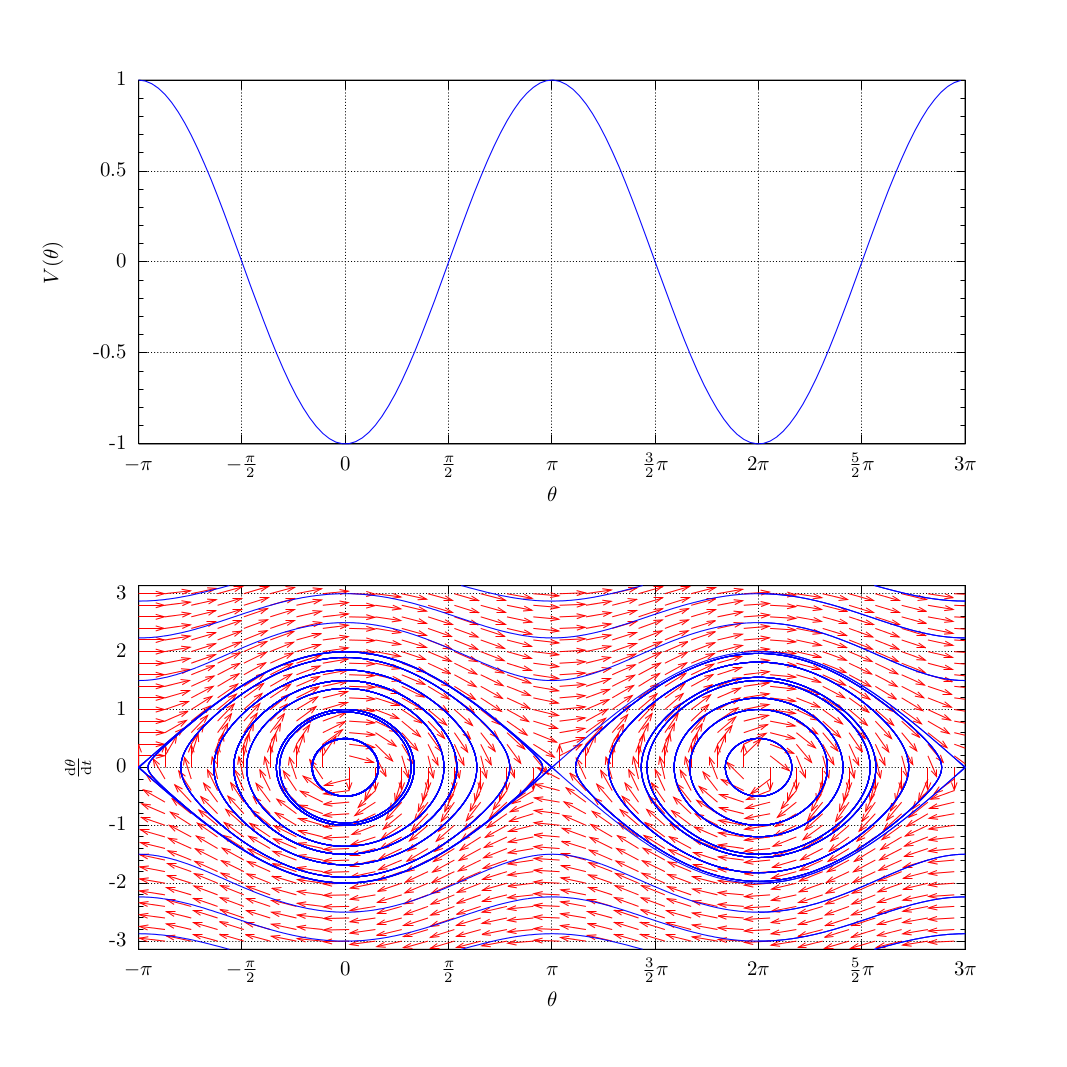
The simple plane pendulum $$\frac{d^2\theta}{dt^2} + \frac{g}{l}\sin{\theta} = 0$$
has the very perdy phase portrait
 Meanwhile, a domain coloring of $\sin(z)$ in the complex plane is

Why are these so similar?
The simple plane pendulum $$\frac{d^2\theta}{dt^2} + \frac{g}{l}\sin{\theta} = 0$$
has the very perdy phase portrait
Meanwhile, a domain coloring of $\sin(z)$ in the complex plane is
Why are these so similar?
 On
On
The equations of the phase curves in the phase portrait of the simple plane pendulum actually correspond to different energy conservation relations: $$ \dot{\theta}^2 - \frac{g}{l}\cos(\theta) = C_0 $$
And in the colored graph of $\sin(z)$ in the complex plane the lines are the lines of constant magnitude: $$ \|\sin(x+yi)\|^2 = C $$ which can be transformed into another form by the steps below $$ \begin{align} \|\sin(x)\cosh(y) + i\cos(x)\sinh(y)\|^2 &= C \\ \sin(x)^2\cosh(y)^2 + \cos(x)^2\sinh(y)^2 &= C \\ (\sin(x)^2 + \cos(x)^2)\frac{e^{2y}+e^{-2y}}{2} + \sin(x)^2-\cos(x)^2 &= C \\ \frac{e^{2y}+e^{-2y}}{2} -\cos(2x) &= C \end{align} $$ when $y$ is not far from $0$, $\frac{e^{2y}+e^{-2y}}{2} \approx 4y^2 = (2y)^2$,so if we replace $(x,y)$ by $(u,v)$ with $u=2x, \, v=2y$, then the equation becomes $$ v^2 -\cos(u) = C. $$ I think this is why the two plots look so similar. When $y$ goes far from $0$, their forms may no longer be such similar.
The trajectories of the differential equation satisfy the implicit equation (with $v = dy/dt$) $$f(\theta,v) = \frac{v^2}{2} - \frac{g}{l} \cos \theta = A, \ A \ge -\frac{g}{l}$$
I think the white curves are the level curves of $|\sin(x+iy)|$. These are given by $$g(x,y) = \cosh (2y) - \cos(2x) = B,\ B \ge 0$$
The two are related by the change of variables $B = Al/g + 1$, $\theta = 2 x$, $v = 2 \sqrt{g/l} \sinh y$.