Why does cross-cancellation of fractions in multiplication work?

1.8k Views Asked by At

I'm reviewing my arithmetic and right now I'm at fractions, I'm just having a little bit of problem "visualizing" why cancellation works in multiplying fractions, I know how it works, it's just the why. Take for example.

$$\frac{2}{3}\cdot\frac{3}{4}=\frac{1}{3}\cdot\frac{3}{2}=\frac{1\cdot1}{1\cdot2}=\frac{1}{2}.$$ Through cancellation we know this ends in 1/2 because the common factor of the numerator "2" and denomaninator "4" is 2, so we divide both by "2" and end with new numbers in place, we also know that the common factor of numerator "3" and denominator "3" is "3" which equals "1" in both places, so it makes the work of "reducing to lowest terms" non-existent since this method is already a shortcut to that.

But I just can't seem to visualize how it works, can you guys give me a visual model to help me make sense of this? thank you.

3

There are 3 best solutions below

0
On

Just write $$\frac{2}{3}:\frac{3}{4}=\frac{2}{3}\cdot\frac{4}{3}=\frac{2\cdot4}{3\cdot3}=\frac{8}{9}.$$

1
On

If you multiply top and bottom of a fraction by the same number it does not change its value e.g. $$\frac{1}{2} = \frac{1\times 2}{2\times 2} = \frac{2}{4}$$ Do the same for your problem $$\frac{\frac{2}{3}}{\frac{3}{4}} = \frac{\frac{2\times 3}{3}}{\frac{3\times 3}{4}} = \frac{2}{\frac{9}{4}}=\frac{2\times 4}{\frac{9 \times 4}{4}} = \frac{8}{9}$$

0
On

This isn't exactly a visual, but the easiest way to see how cross-cancellation works is that multiplication is commutative: you can multiply numbers in any order you want (so, e.g., $2 \cdot 4 = 4 \cdot 2$). Multiplying by $\frac{a}{b}$ is always the same as multiplying by $a$ and then by $\frac{1}{b}$. So $$\frac{2}3 \cdot \frac34 = 2 \cdot \frac13 \cdot 3 \cdot \frac14 = 2 \cdot\frac14 \cdot 3 \cdot \frac13 = \frac24 \cdot \frac33 = \frac24 \cdot 1 = \frac24$$

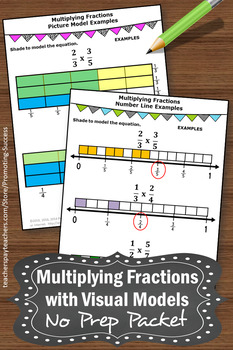
Here's a visual that might help: you can represent $\frac23 \cdot \frac34$ by taking a rectangle, dividing it lengthwise into $3$ and widthwise into $4$, and then taking a subrectangle of length $2$ along the length and $3$ along the width. But this subrectangle is the same size as a rotated subrectangle of length $3$ along the length (i.e., the entire length!) and $2$ along the width. This is clearly $\frac{2}4$ since it takes up the entire length and $2$ out of $4$ along the width.

For an actual visualization of that (since I don't think my explanation was great), refer to this image I found off Google of $\frac23\cdot\frac35$: https://ecdn.teacherspayteachers.com/thumbitem/50-Off-1st-24-Hrs-Fractions-Grade-5-Multiplication-with-Visual-Models-NO-PREP-1294713-1502670899/original-1294713-4.jpg The green rectangle is $2\times3$; imagine taking a $3\times2$ rectangle instead.