Here is the statement of problem 26 of chapter 5 from Morandi's Field and Galois Theory:
Let $K/F$ be a normal extension and let $L/F$ be an algebraic extension. If either $K/F$ or $L/F$ is separable, show that $[KL:L] = [K:K \cap L]$ Give an example to show that this can be false without the separability hypothesis.
Let's assume that the extensions are finite. If $K/F$ is separable, then it is Galois, and the theorem on natural irrationalities applies (the theorem states that $\mathrm{Gal}(KL/L) \cong \mathrm{Gal}(K/K\cap L)$. If we only assume $L/F$ to be separable, then I am stuck. I tried using the primitive element theorem, so that $L = F(a)$ for some $a \in L$ and then show that $[K(a):F(a)] = [K:K\cap F(a)]$, but I can't get anywhere with this.
I'm also a bit surprised by this problem; the theorem on natural irrationalities is fairly well-known, but everywhere I have seen it is stated with the assumption that $K/F$ is Galois. I was hoping that someone could provide some insight on how to do this, or a source for a proof that doesn't use the assumption that $K/F$ is Galois.
Edit: A tiny bit of progress. Let $L/F$ be separable. If $\min(F,a)$ has a root in $K$, then it splits over $K$ by normality of $K/F$. Therefore, $a \in K$, and $K(a) = K$ and $K \cap F(a) = F(a)$. The degree formula follows trivially in this case. We can then assume that the none of the distinct roots of $\min(F,a)$ lie in $K$.

Assume that $L/F$ is separable, and note that$[KL:L]=[K:K\cap L]\Leftrightarrow [KL:K]=[L:K\cap L]$.
Let $L'$ be the normal closure of $L$. Because $L/F$ is separable, then $L'/F$ is separable, therefore is Galois. By natural irrationalities, $[KL':K]=[L':K\cap L']$
and \begin{alignat*}{1} [KL':K]&=&[L':K\cap L']\\ \Leftrightarrow [KL:K] &=& \frac{[L':L][L:K\cap L]}{[KL':KL][K\cap L':K\cap L]}\tag*{(1)} \end{alignat*}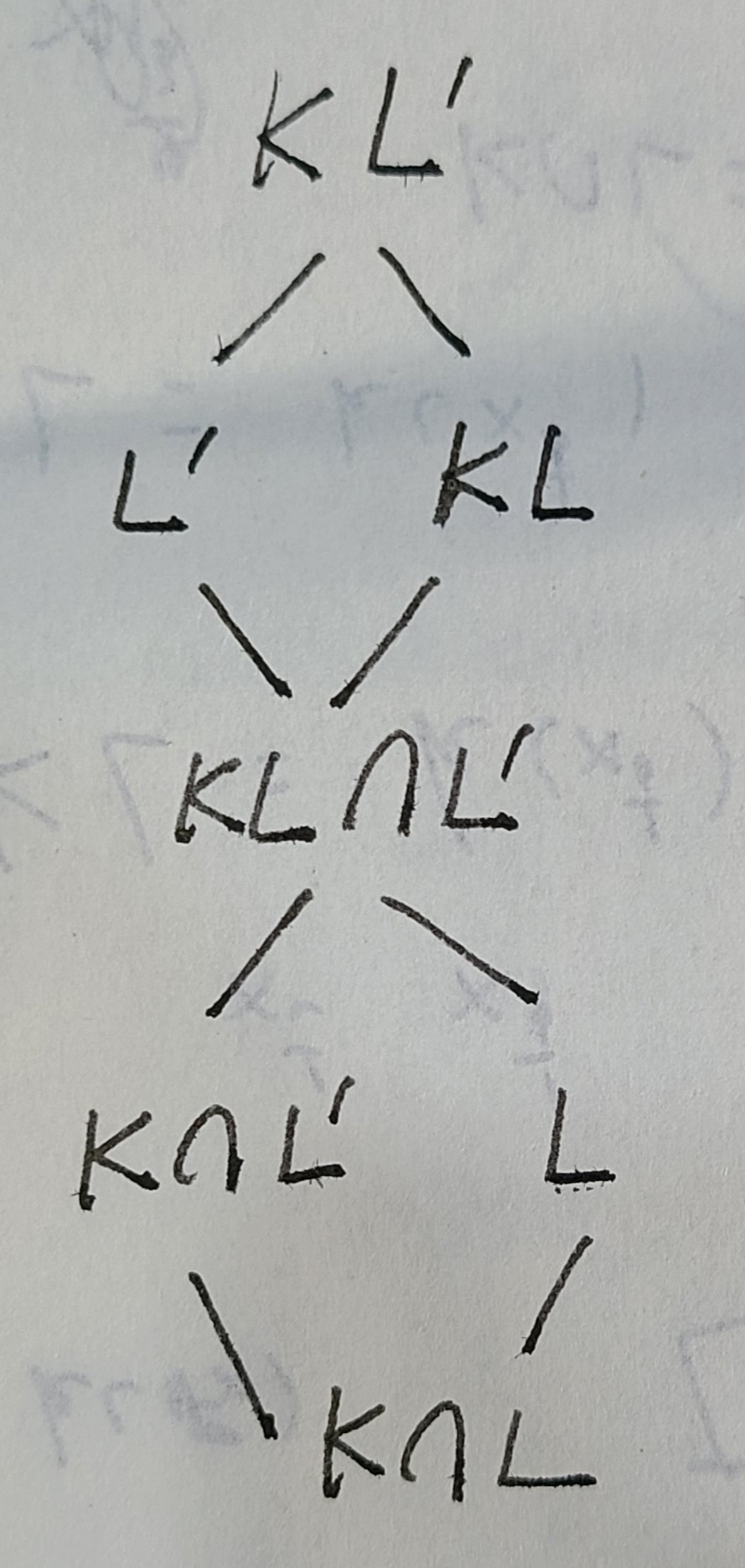
By natural irrationalities \begin{alignat*}{1} [KL':KL]&=&[L':KL\cap L']\tag{2}\\ [KL\cap L':L]&=&[(K\cap L')L:L]\\ &=&[K\cap L':K\cap L'\cap L]\\ &=&[K\cap L':K\cap L]\tag{3} \end{alignat*}
Then we have
\begin{alignat*}{1} [KL':KL][K\cap L':K\cap L]&=[L':KL\cap L'][KL\cap L':L]\tag*{by (2)(3)}\\ &=[L':L]\\ \Rightarrow 1&=\frac{[L':L]}{[KL':KL][K\cap L':K\cap L]}\\ \Rightarrow [KL:K] &= [L:K\cap L]\tag*{by (1)}\\ \Leftrightarrow [KL:L]&=[K:K\cap L]\tag*{QED} \end{alignat*}