The following is from Hatcher's book on Algebraic Topology:
we first start with a discrete set $X^0$ whose points are $0$-cells. Then "Inductively, form the n skeleton $X^n$ from $X^{n−1}$ by attaching n-cells $e^{n}_{\alpha}$ via maps $\varphi_α : S^{n−1} \rightarrow X^{n−1}$ . This means that $X^n$ is the quotient space of the disjoint union $X^{n−1} \coprod_{\alpha}D_{\alpha}^{n}$of $X^{n−1}$ with a collection of $n$-disks $D_{\alpha}^{n}$ under the identifications $x \sim \varphi_{\alpha}(x)$ for $x \in \partial D_{\alpha}^{n}$. Thus as a set, $X^n = X^{n-1} \coprod_{\alpha} e^{n}_{\alpha}$ where each $e^{n}_{\alpha}$ is an open n-disk."
First, I know that we use "attachment maps" to get $\varphi_α : S^{n−1} \rightarrow X^{n−1}$ which is the "$n-1$-skeleton". I however do not understand what is going on when we take:
"the identifications $x \sim \varphi_{\alpha}(x)$ for $x \in \partial D_{\alpha}^{n}$." I see that $x \in S^{n-1}_{\alpha}$ which is the boundary of $D_{\alpha}^{n}$ and furthemore, such as depicted in the picture here: http://upload.wikimedia.org/wikipedia/commons/4/44/Disk_to_Sphere_using_Quotient_Space.gif and I know that I know that $D^2/\partial D^2 = S^2$
I am taking the $x \in \partial D^2$ or $x \in S^1$, and that I am taking that $x$ and mapping it through $\varphi_{\alpha}(x)$ to $X^{n-1}$, but what is this $X^{n-1}$? Looking at the picture of the sphere above is $X^{2-1} = X^1 = S^1?$ and so is this just some sort of pattern as in the case of spheres which we will end up with $\varphi_α : S^{n−1} \rightarrow S^{n−1}$ which I don't see what the point is in this map. Furthermore though we would have that $S^n = S^{n-1} \coprod_{\alpha} e^{n}_{\alpha}$ which wouldn't be right as $D^n = S^{n-1} \coprod_{\alpha} e^{n}_{\alpha}$ (if I am correct).
In the end, I don't see how these $n$-skeletons work and how we are building up larger spaces by adding open balls (cells).
Any insight is appreciated.
Thanks,
Brian

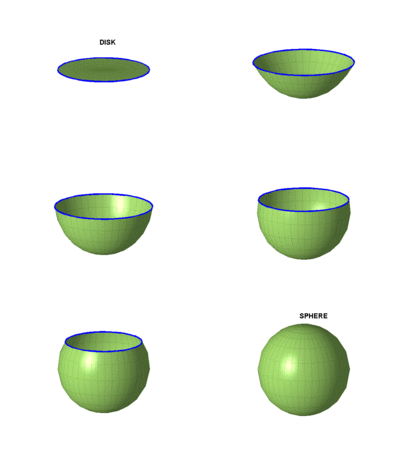
As noted on the next page of the book, $S^n$ has a particularly simple CW decomposition. The recipe is simple - take $D^n$ and identify the boundary to a point. To be super formal about it, let $e^0$ denote a $0$-cell and attach an $n$-cell to it via the constant identification map $\phi : S^{n-1} \rightarrow e^0.$ This process gives us the space $Y = D^n \coprod e^0 / \sim ,$ where $x\sim e^0$ for all $x\in S^{n-1}.$ To see that this really works, consider the map.
$\rho_1 : Y \setminus e^0 \rightarrow \mathbb{R}^n$ by
$x\mapsto \frac{x}{1- |x|} $
Composing this map with the inverse of the stereographic projection map and extending to $Y$ by sending $e^0$ to the north pole of $S^n$ gives the desired homeomorphism. Thus the full cell-decomposition of $S^n$ is as follows
$X^0 = e^0$
$X^1 = e^0$
$\, \, \, \, \, \, \, \, \, \, \, \vdots $
$X^{n-1} = e^0$
$X^n = Y$
$X^{n+1} = Y$
$\, \, \, \, \, \, \, \, \, \, \, \vdots $