Somewhat related to this question, but almost infinitely more basic.
A Confession
I am, should classification prove essential, a differential geometer and a topologist by inclination and by training: as an undergraduate I shunned any ring that wasn't $\mathbb{Z}_n$ or a ring of differential operators and held close the differentiable and the non-singular. It did not seem to matter then that these exotic 'schemes' and their exciting projective morphisms were beyond me, and to a certain extent it does not seem to matter now; but increasingly my old uni friends, fellow MOers (and, hey, even math.stack exchangers) are talking about nothing else but schemes.
In recent months (after a frighteningly eye-opening MO question) I have found myself becoming more amenable to rings, and am less daunted by my paucity of understanding than previously. In spite of this, though, I remain entirely in the dark about schemes.
Where I Sit
I am not a complete novice. I completed an undergraduate course in algebraic geometry: illuminating, interesting, but all classical beyond belief. I have read and re-read the wikipedia page on schemes several times- taking in all of the neccessary components: the spectrum of a ring, a locally ringed space et al, but have no idea how these fit together to make the objects I fiddled with over a semester two years ago.
I have made numerous guesses about generalised nulstellensatze and structure sheaves, but to explain any would probably be to complicate matters further unneccessarily. I am aware there are probably brilliant texts that do exactly what I am asking for, but I am not currently affiliated to a university and my current library would require ordering in, which for the sort of toe-dipping excercise I intend here would be overkill. So I ask:
Can anyone provide me with a canonical example of a scheme, pointing along the way the topology and the spectra associated to each open set. Perhaps deeper, if it pleases: what I am looking for is a sort of 'scheme jargon safari'.
I am aware this is silly, and perhaps asking for a verbatim quotation of page 2 of any decent algebraic geometry text, but I would be ever so grateful. Can anyone help?

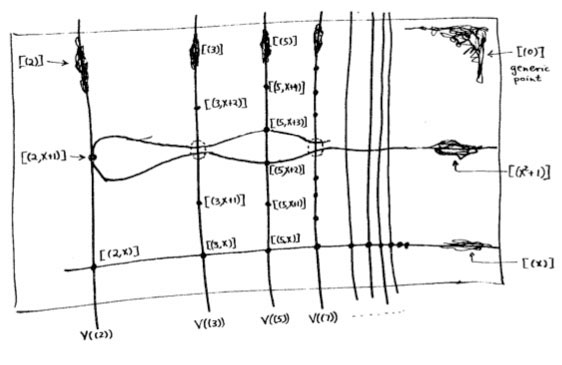
I am going to consider everything here over the field $\mathbb C$. You can replace $\mathbb C$ by any algebraically closed field (or even any field) with essentially no changes, but working over $\mathbb C$ is the natural starting point, and has the advantage that one can connect with the kind of geometry/topololgy with which you are more familiar.
Given a classical variety $V$, you can consider all the closed subvarieties. These satisfy the axioms of a topology, called the Zariski topology. For definiteness, let's say that our variety is an affine variety, so it is being cut out by polynomials in $\mathbb C^n$, for some $n$. The usual topology on $\mathbb C^n$ induces a topology on $V$, which has many more open sets than the Zariski topology (unless $V$ is $0$-dimensional). The point is that to be closed in the Zariski topology, you have to really be the zero locus of some polynomial, i.e. another variety, so it is hard to be Zariski closed, and hence similarly hard to be Zariski open. (Just to be absolutely clear, let's look at an example: the real line is closed in $\mathbb C$, but is not Zariski closed; there is no polynomial in one variable over $\mathbb C$ that vanishes precisely on the points of the real line; indeed, such a polynomial either vanishes at only finitely many points, or else is identically zero, and so vanishes everywhere.)
You also have the notion of rational function on the variety (just think of the restriction of a ratio of polynomials in $n$-variables to $V$, such that the denominator does not vanish identically on $V$); a rational function is called regular at a point $P$ of the variety if it has no singularity at that point. Being a singularity is a Zariski closed condition (singularities occur where the denominator of the rational function, which is a polynomial, vanish), so being regular at a point is a Zariski open condition. If we fix a Zariski open set in advance, we can look at the ring of all rational functions that are regular on that open set.
These form a sheaf on $V$ (with its Zariski topology). It is much "smaller" than the sheaves you are used to, like smooth or continuous functions. Not only are there many fewer open sets to think about (just the Zariski open ones), but on a given open set, there will be incredibly more continuous or smooth functions than regular functions, just because being the ratio of polynomials is a very restrictive condition on a function.
If we look at the global sections of this sheaf, i.e. the functions that are regular on the whole of $V$, we in particular get a ring which is called the affine ring of $V$. If I just hand you this ring (as a $\mathbb C$-algebra), it turns out that you can recover $V$, namely $V$ is the maximal spectrum of this ring (i.e. point of $V$ are in natural bijection with maximal ideals of $V$). The map one way is easy: given a point, we can look at all regular functions on $V$ that vanish at the point; this gives a maximal ideal in the ring of all regular functions. That this is a bijection is harder, and is essentially equivalent to the Nullstellensatz.
To see the role of the entire spectrum of the ring (i.e. the prime ideals as well as the maximal ideals) one has to say and think about more, but this is probably enough for now.
To learn more, you should google "affine ring of a variety" or similar expressions, and you should find troves of information, at a great range of levels. Once you understand this basic connection, it makes sense to look at schemes in more detail.