I've been teaching calculus for several years and have some doubts about whether derivatives (and integration techniques) of common functions are useful and important outside mathematics and physics.
My question is:
Can you give an example of a natural problem outside mathematics and physics that can be solved using derivatives or integration, and cannot be solved simpler differently?
My motivation comes from trying to motivate students by good exercises.
The first constraint (naturality) excludes exercises such as "If $q$ units are produced in a factory, then your cost is $-0.3q^3+2q^2-\ldots$" and all of that kind, taught in microeconomics courses. The second constraint (cannot be solved simpler) exclude, for example, everything that leads to a minimum or maximum of quadratic expressions.
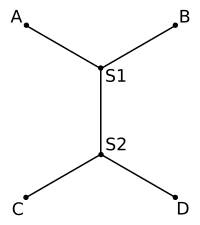
I'm aware of a few such instances, for example determining the length of the line segments in the solution of the Steiner tree problem for four points on a square (minimal road or electricity network connecting ABCD).

There are plenty of differential equations in biology. The list from Wikipedia is:
Verhulst equation – biological population growth
von Bertalanffy model – biological individual growth
Lotka–Volterra equations – biological population dynamics
Replicator dynamics – found in theoretical biology
Hodgkin–Huxley model – neural action potentials
And there are also ones coming from pharmacokinetics.
Of course you don't actually have to use the real differential equations coming from these fields, you could choose the mathematics you want to ask about (for example, a PDE) and then just say