So here's a question. What is the best way to approximate this: $$\sqrt[r]x$$
Here is a few method I found, but I am not sure which is faster:
brute force. The most straight forward and easiest. Just choose an arbitrary number and multiply it r times and if it is too big you make it smaller, too small you make it bigger. The best thing about this method is that you would always have a upper bound and lower bound and so you can very easily increase the percision by continuously trying new number.
another option is try to find an infinite fraction and just stack them. so for example the fraction for squareroot 2 is:
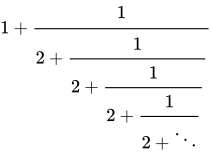
the problem with this method is that I can't reliability find the fraction for every root.
- natural log and e. with some manipulation the same equation could be rewrite as the following: $$e^{\frac {\ln x}r}$$
although the equation looks the same but because the behavior of e, e^x, ln(x) are all very well defined we probably can get something interesting.
for instance d/dx e^x = e^x and ln(x) is the inverse of e^x. So perhaps if we can find a good model to approximate e^x, this problem would become much easier.
I also see some answer suggested here: math stack exchange question. although i didn't really see how they got this: $$\left(\frac{x^{\frac 1{2^{10}}}-1}r+1\right)^{2^{10}}$$
i am guessing that they uses the definition of e:
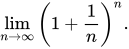
I don't really know. I find some interesting things in this wiki article but nothing that could crack this problem.
Which solution looks more plausible why and how should I carry out the calculation. Please help. Thank in advance.

Seems like they are doing this: $$ \left(\frac{x}{n}+1\right)^{k} = \left(\frac{x}{n}+1\right)^{n(k/n)} \approx e^{xk/n} \approx \left(\frac{x}{k/n}+1\right)^{k/n} $$ Following this reasoning we have $$ \left(\frac{x^{1/n}-1}{r}+1\right)^{n} \approx \left(x^{1/n}-1+1\right)^{n/r} = x^{1/r} $$