Are all mathematicians human calculators?

14.4k Views Asked by At

I asked my dad why he did not major in math he said "because he is not good at math". I think I like math, and I think I'm ok at it, but I'm not gifted or anything like that, I just like math. I think I'd like to major in math, but I see all these documentaries about great mathematicians and they can all multiply and divide numbers off the top of their heads and I certainly cannot. I realize that we have calculators, but somehow I don't think I should go into math.

As a forum/site of math people, what do you think?

Sorry if this is kind of a random question with no definite answer and probably out of place. My tags are probably wrong too, sorry.

EDIT: Mostly, i think I'm worried that I don't have a high enough IQ to ever contribute anything to the field of mathematics. I think I'll only study the work of others and never have my own work. It seems like people who are successful in mathematics are people who are talented by nature, like they have a really high IQ (yes, IQ is just a number, but you know what I mean) and math comes easily to them. For those people, it seems like math is effortless, but I wouldn't know.

11

There are 11 best solutions below

0
On

The short answer is no.

Mathematics, at the more advanced levels, very quickly ceases to be computational as you described in your question. Your ability to carry out complicated calculations mentally, while neat and impressive, does not really matter once you're asked to prove theorems.

The confounding variable here is that being able to do quick mental arithmetic is usually indicative of mathematical familiarity or mathematical maturity - when you do a lot of math, you get exposed to tricks that make these computations faster, and you become better at them by practice. For example, I can divide $1024$ by $128$ in a split-second, because I know one is $2^{10}$ and the other is $2^7$, so the result is $2^{10-7} = 2^3 = 8$.

If you think you like math, just do a lot of math! Don't be afraid.

4
On

I certainly didn't study mathematics to develop abilities to make trivial calculations at high speeds, albeit I was always good at that sort of thing in elementary school.

Math is a lot more than just calculations. In fact, it has almost nothing to do with calculation.

3
On

I am thinking exactly the opposite. To me many mathematician are bad in doing explicit calculation. They are so concentrated on those abstract thinking and almost never do explicit calculations.

You might search for "Grothendieck prime 57", which is (I think) a canonical answer to your question.

4
On

No.

Part of the curriculum for math majors is logic. Now, logic may not seem to math-like, but logic is the language of mathematics. Once you understand logic, you can move on to topics such as algebra (not that crap they teach you in grade school), set theory, combinatorics, graph theory, and all types of other good stuff. In learning this, you gain a fundamental understanding of numbers, how they work together, all the different things you can do with them, nice tricks to solve seemingly hard problems easily (this especially if your in to number theory), and whatnot. This doesn't account for your 'human calculator' description, but a solid understanding of numbers certainly helps.

Another thing is practice. The more you work with numbers, the more comfortable you get with them.

While it is true that there are some mathematicians who were naturally gifted (Ramanujan, Euler, Newton, and more), they are by no means normal. Normal mathematicians started just as you are: clueless, but willing to learn.

I don't know what grade level you are in, but I'm going to go ahead and assume your in high school. Make sure you know your algebra and trig very well before going into college. Nothing too crazy, but understand logs/exponentials, trig functions and their inverses, the unit circle, factoring of 2nd and 3rd degree polynomials, and graphing common functions (x, e^x, ln(x), x^2, x^3, etc etc). You will need a good grounding of this to get through calculus and into higher level math.

Sincerely, A current math major

edit: and now that I look at your recent history, I see that, no, you are not in high school. Or at least if you are, your learning induction and trying to prove the cauchy-schwarz inequality. Whelp, oh well, I already wrote this out :P

5
On

We invented computers to avoid precisely that...

11
On

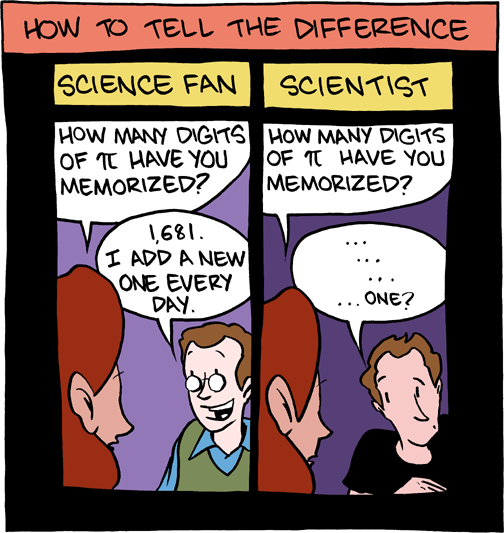
Replace the captions in the below comic with "math fan" and "mathematician" and it will convey the spirit of the truth (link to original) :

smbc

0
On

In considering this i think the phrase "human calculators" is limiting. A calculator is programmed at doing one thing: rendering a numeric value/answer based only on numeric input. While a human being is obviously much more. You see where i'm headed with this. So the question itself is actually limited to a simple "yes" or "no". Of course my answer is NO.

Mathematicians are much more that "human calculators".

3
On

Although some of the great mathematicians definitely were also phenomenal calculators, I do not think that this is necessary for being a mathematician.

In general, I would say that mathematicians and pseudomathematicians may be divided into three categories (of course, dividing people into categories is always problematic, so what follows is not meant to hold without exceptions):

  • People that remember 1000 digits of $\pi$, multiply ten-digit numbers in several seconds, and similar stuff. In fact, this has usually more to do with autism than with mathematical talent. Although there may be some exceptions, these people usually are not real mathematicians, since their focus is very far away from understanding things. Our local radio once hosted a boy that holds a national record in the number of digits of $\pi$ remembered. However, he seemed to know almost nothing about why the number $\pi$ is useful.
  • Great calculators. Some mathematicians in history, e.g. Leonhard Euler, were exceptionally skillful in performing algebraic and numerical calculations. This kind of people should not be confused with those mentioned in the first point. In fact, before computers have been invented, mastering the craft of performing calculations was a must. It still may be useful today, but computers make things little bit easier also for people that are not so good at these things.
  • Horrible calculators. Although some skill in performing calculations is undoubtedly useful, it does not appear to be the most important thing. In fact, there are also some really horrible calculators amongst professional mathematicians. Mathematics, as well as the rest of science, philosophy, and art, is mainly a creative discipline. Most of really good mathematicians certainly have a sort-of artistic soul. Creativity is what matters the most.

I would say that there are two different levels of mathematics: the craft of mathematics and the art of mathematics. Mastering the craft is certainly useful, but you do not have to be phenomenal in it, in order to be good at mathematics. The art of mathematics is much more important and I doubt that any important mathematician in history was solely a craftsman.

0
On

No, because of intelligence and creativity, something we have a great deal of trouble implementing into computers, and it may even be impossible to get computers to mimic. The best computers today can solve maybe 1% of the questions on this site, while lousy calculators we are superior problem solvers.

0
On

Not only is great prowess at mental arithmetic not necessary (as everyone has sufficiently pointed out), but knowledge of mathematics can help you avoid doing a lot of calculation. You probably know the famous (and apparently even true) story about Gauss in elementary school: Instead of adding the numbers from 1 to 100, he figured out that their sum is equal to 50 * (1 + 100). Bypassing boring calculations is a great reason to develop mathematical insight, in my opinion...

1
On

$$\text{arithmetic} : \text{mathematics} \quad::\quad \text{spelling} : \text{ literature}$$