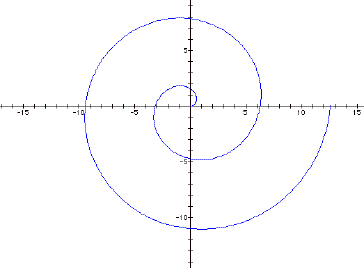
I'm interested in finding the area under the curve described by θ=ar, which is a linear curve with slope 'a' in polar coordinates. Here is what the curve looks like:
http://jwilson.coe.uga.edu/emt668/EMAT6680.2003.Su/Schulte/SchulteA11/SchulteA11_files/image010.gif
My thoughts on the problem:
1) To find the area, you'd probably need to use the jacobian.
2) Instead of using the slope 'a', it might be more helpful to use 2π/r0, where r0 is the radius you want at angle 2π.
3) The definition of "area" changes when θ > 2π. From what I understand to find the TOTAL area between, say θ = 8π and θ = 0, you would actually integrate from θ = 8π and θ = 6π. Although perhaps this is thinking a bit too far ahead...
So yeah, if someone can explain how to set up the problem/integral it would be much appreciated.

I'm hoping this is relevant to your problem. The area of a polar function $r(\theta)$ is given by... $$A=\int_{\alpha}^{\beta} {1 \over 2} \cdot r^2 \ d \theta$$ (This is fairly intuitive, its exactly like the area formula for a circle, except now its in integral form to allow tiny radius changes to be summed up to a total area. Test this out on a constant $r(\theta)$ to see how it gives the area of a circle.)
The domains of integration are angles. In your case, its very easy to convert $\theta(r)$ to $r(\theta)$. Your function is given by... $$r(\theta)={\theta \over a}$$ Thus the area is given by... $$A=\int_{\alpha}^{\beta} {1 \over {2 \cdot a^2}} \cdot {\theta}^2 \ d \theta$$ $$\Rightarrow A={{\beta^2-\alpha^2} \over {4 \cdot a}}$$