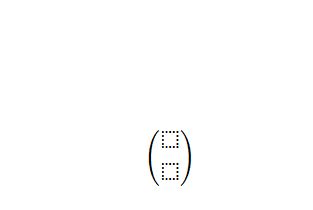
I saw the formula of negative binomial expression here Here I know that in common notion is that the numbers in large bracket just after sign of summation represents combination of below w.r.t to above.Here can you tell me how do we involve negative number in combination & do (-n)Ck.Means how can we find combination of negative number (-n) here
2026-04-09 15:21:36.1775748096
Combination of negative term in negative Binomial expression.
814 Views Asked by Bumbble Comm https://math.techqa.club/user/bumbble-comm/detail At
1
There are 1 best solutions below


Related Questions in BINOMIAL-COEFFICIENTS
- Newton binomial expansion
- Justify an approximation of $\sum_{n=1}^\infty G_n/\binom{\frac{n}{2}+\frac{1}{2}}{\frac{n}{2}}$, where $G_n$ denotes the Gregory coefficients
- Solving an equation involving binomial coefficients
- Asymptotics for partial sum of product of binomial coefficients
- What is wrong with this proof about a sum of binomial coefficients?
- Find sum of nasty series containing Binomial Coefficients
- Alternating Binomial Series Summation.
- $x+\frac{1}{x}$ is an integer
- Finding value of $S-T$ in $2$ binomial sum.
- how to reduce $(1-\alpha)^{T-i}$ into a sum
Related Questions in COMBINATIONS
- Selection of "e" from "e"
- Selection of at least one vowel and one consonant
- Probability of a candidate being selected for a job.
- Proving that no two teams in a tournament win same number of games
- Selecting balls from infinite sample with certain conditions
- Divide objects in groups so that total sum of sizes in a group are balanced across groups
- Value of n from combinatorial equation
- Number of binary sequences with no consecutive ones.
- Count probability of getting rectangle
- Sum of all numbers formed by digits 1,2,3,4 & 5.
Related Questions in BINOMIAL-THEOREM
- Prove $\sum^{n}_{i=1}\binom{n}{i}i=n2^{n-1}$ using binomial and induction
- Use the binomial theorem to prove that for $n$ a positive integer the following holds
- Proving the binomial series for all real (complex) n using Taylor series
- Find sum of nasty series containing Binomial Coefficients
- Value of $a_2+a_6+a_{10}+\cdots+a_{42}$
- Definite sum for $(1+a)^n$
- How to prove $\sum_{r=1}^{n} r^{2}\binom {n} {r} = n(n+1)2^{n-2}$?
- Binomial Theorem Question $1+(1+x)+(1+x)^2+\dots+(1+x)^n$
- Distinct terms in a binomial expansion
- Limit of a sequence (binomial series and generating function for Catalan)
Related Questions in NEGATIVE-BINOMIAL
- Probability: Negative binomial mode trouble (Exam P SOA 140)
- Fitting Count Data with Poisson & NBD
- How to find the missing terms
- Negative Binomial Distribution Question
- Why are there different forms of the negative binomial distribution?
- Variance of Negative Binomial Distribution
- What is the probability it will take more than 20 people..?
- Poisson and Negative Binomial distributions- Mean and Variance total claim size
- Geometric to Negative Binomial
- Why does the negative stay with the fraction after factoring out a -1 when dealing with opposite factors?
Trending Questions
- Induction on the number of equations
- How to convince a math teacher of this simple and obvious fact?
- Find $E[XY|Y+Z=1 ]$
- Refuting the Anti-Cantor Cranks
- What are imaginary numbers?
- Determine the adjoint of $\tilde Q(x)$ for $\tilde Q(x)u:=(Qu)(x)$ where $Q:U→L^2(Ω,ℝ^d$ is a Hilbert-Schmidt operator and $U$ is a Hilbert space
- Why does this innovative method of subtraction from a third grader always work?
- How do we know that the number $1$ is not equal to the number $-1$?
- What are the Implications of having VΩ as a model for a theory?
- Defining a Galois Field based on primitive element versus polynomial?
- Can't find the relationship between two columns of numbers. Please Help
- Is computer science a branch of mathematics?
- Is there a bijection of $\mathbb{R}^n$ with itself such that the forward map is connected but the inverse is not?
- Identification of a quadrilateral as a trapezoid, rectangle, or square
- Generator of inertia group in function field extension
Popular # Hahtags
second-order-logic
numerical-methods
puzzle
logic
probability
number-theory
winding-number
real-analysis
integration
calculus
complex-analysis
sequences-and-series
proof-writing
set-theory
functions
homotopy-theory
elementary-number-theory
ordinary-differential-equations
circles
derivatives
game-theory
definite-integrals
elementary-set-theory
limits
multivariable-calculus
geometry
algebraic-number-theory
proof-verification
partial-derivative
algebra-precalculus
Popular Questions
- What is the integral of 1/x?
- How many squares actually ARE in this picture? Is this a trick question with no right answer?
- Is a matrix multiplied with its transpose something special?
- What is the difference between independent and mutually exclusive events?
- Visually stunning math concepts which are easy to explain
- taylor series of $\ln(1+x)$?
- How to tell if a set of vectors spans a space?
- Calculus question taking derivative to find horizontal tangent line
- How to determine if a function is one-to-one?
- Determine if vectors are linearly independent
- What does it mean to have a determinant equal to zero?
- Is this Batman equation for real?
- How to find perpendicular vector to another vector?
- How to find mean and median from histogram
- How many sides does a circle have?
If $n$ and $k$ are positive integers with $k\le n$ then the formula $${n\choose k}={n(n-1)(n-2)\cdots(n-k+1)\over k!}$$ has a combinatorial interpretation as the number of ways of choosing $k$ things from $n$ things. When $n$ is not a positive integer with $k\le n$, the formula no longer has that combinatorial interpretation, but it still indicates a legal computation, and is taken to be the definition of $n\choose k$. And even though it doesn't have that combinatorial interpretation, it still has many uses in combinatorics and elsewhere (to begin with, in the general form of the Binomial Theorem).