Compute the fundamental group and the first homology group of two discs attatched to $S^1$.

220 Views Asked by At

Let $X$ be the space obtained by attaching two discs to the circle $S^1$. The first disc is attached by its boundary via the map $z \mapsto z^3$ and the second disc is attached by its boundary via the map $z\mapsto z^5$. How do I compute the fundamental group and the first homology group.

I understand that I need to use the Seifert-van Kapen theorem.

2

There are 2 best solutions below

0
On BEST ANSWER

Call the discs $U_1,U_2.$ we want to know the fundamental group of $X=U_1\cup U_2.$ and will use Seifert-van Kampen. From Wikipedia: pushout diagram
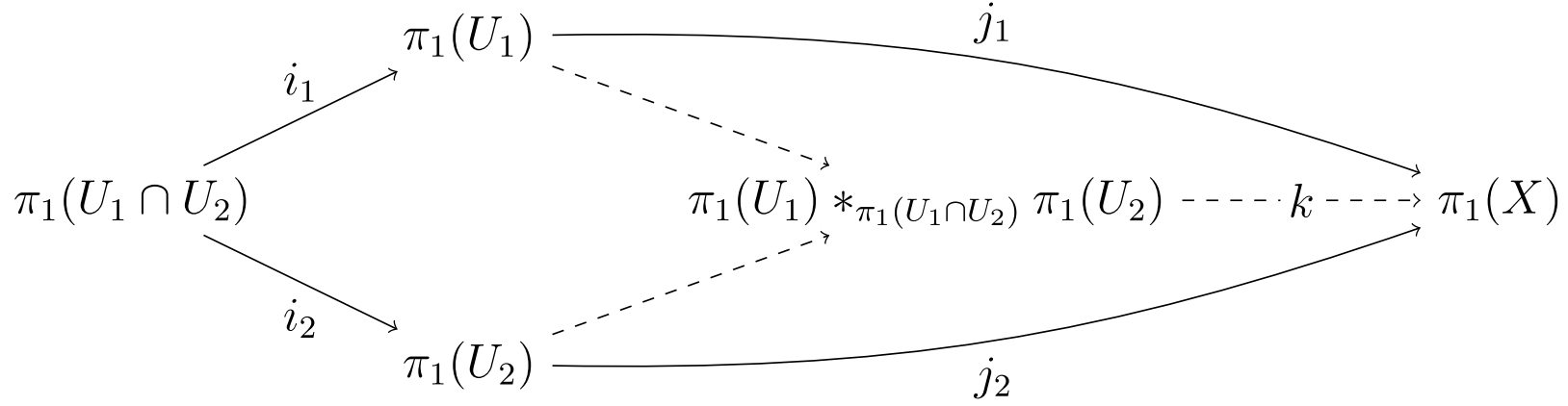
Let $\pi_1(U_1\cap U_2)=\langle a\rangle, \pi_1(U_1)=1, \pi_1(U_2)=1.$ Then we get $i_1 : a\mapsto 1,$ and $i_2 : a\mapsto 1.$ and we can write down:

$$\pi_1 X = 1 \ast_{\Bbb Z} 1 = \langle a | a =1, a = 1\rangle = 1.$$

But then we probably could have guessed that answer without working it out.

0
On

Take the first attaching map $D^2 \to S^1$ by $z \mapsto z^3$. It's clear that a loop in $S^1$ becomes trivial after wrapping it around three times, so the fundamental group here is $$\langle a \mid a^3=1 \rangle=\mathbf Z_3$$ where $\langle a \rangle=\pi_1(S^1).$

Likewise the second relation gives that $\langle a \mid a^5=1\rangle$ and together, these relations imply that $a^3=a^5=1$ or $1=a^2=a^{3}$ and so $a=1$ follows meaning that the group is trivial.


A way the first argument precise is that the universal cover of the first map attached by $z \mapsto z^3$ is three disks attached by identity to their boundary, where deck transformations are cyclic permutations of these disks, which gives you the desired fundamental group.