The exercise is to construct a cube (inscribed in the unit spher) with one of the corners at: $$ \vec{v} = \frac{1}{\sqrt{10}} (3,1,0) \in S^2 $$
I'm a bit stuck constructing the other seven vertices. My first guess was to use the eight reflections available to me:
$$ \square \stackrel{?}{=}\left\{ \tfrac{1}{\sqrt{10}} (\pm 3, \pm 1, \pm 0) \right\} $$
This is not quite right since this describes the four vertices of a rectangle in 3-dimensional space. I remember the rotations of the form a group. Here is one of the matrices:
$$ \left[ \begin{array}{rrrr} 0 & -1 & 0 \\ 1 & 0 & 0 \\ 0 & 0 & 1 \end{array}\right] \in SO(3) $$
This would lead to the 4 vertices of a square (up to rescaling). Then I am stuck finding the remaining four.
- $ (3,1,0)\;,\; (1,-3,0)\;,\; (-3,-1,0)\;,\; (-1,3,0) $
The algebra would give these vertices, but having the orientation of the cube slightly off vertical is enough to confuse my intuition. Perhaps I could use another matrix:
$$ \left[ \begin{array}{rrr} 1 & 0 & 0 \\ 0 & 0 & -1 \\ 0 & 1 & 0 \end{array}\right] \in SO(3) $$
This generates a few more verties (including some repeats). This brings the count up to six.
- $ \color{#A0A0A0}{(3,1,0)}\;,\; (3,0,-1)\;,\; (3,-1,0)\;,\; (3,0,1) $
The rotations of the cube are an isometry, so I should be able to generate the cube as the $SO_3(\mathbb{Z})$ orbit of a single vector. It's hard to decide on paper if I'm on the right track.
Following the comments Here's a third orthogonal matrix: $$ \left[ \begin{array}{rrr} 0 & 0 & -1 \\ 0 & 1 & 0 \\ 1 & 0 & 0 \end{array}\right] \in SO(3) $$
and we get (up to) three more verices. So far we have 7 and we're only looking for one more.
- $ \color{#A0A0A0}{(3,1,0)}\;,\; (0,1,-3)\;,\; (-3,1,0)\;,\; (0,1,3) $
We are up to ten vertices. So there is definitely a problem. There are $|SO(3, \mathbb{Z}) | = 24$ and we're computing the orbit correctly, but we are off a factor of three. We have obtained three interlocking cubes.
What subset of $SO(3)$ should I be using?
Generically the image of a point is the compound of three cubes. So this construction is redundant by a factor of three.
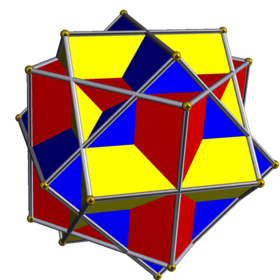
Let's type out the possible vertices:
 a  b  c | -b  a  c | -a -b  c
 a -c  b | -b -c  a | -a -c -b
 a -b -c | -b -a -c | -a  b -c
 a  c -b | -b  c -a | -a  c  b

-c  b  a |  c  a  b |  b -a  c
-c -a  b |  c  b -a |  b -c -a
-c -b -a |  c -a -b |  b  a -c
-c  a -b |  c -b  a |  b  c  a
The group theory suggests these should split into three groups of eight, forming the three cubes. I wasn't able to find the correct permutations.
If I had set $\vec{v}_0 = \frac{1}{\sqrt{3}}(1,1,1)$, then the vertices $\frac{1}{\sqrt{3}}(\pm 1,\pm 1,\pm 1)$ are the vertices of a cube.

HINT
1) Find the opposite corner: $\vec{w}=-\vec{v} = -\frac{1}{\sqrt{10}} (3,1,0) \in S^2 $
2) Find the vertical axis $A$ of the cube, i.e. the line through the origin which form an angle $\alpha$ s.t. $\cos \alpha=\frac {1}{\sqrt 3}$ with the line $\vec v-\vec w$
3) Find the others 6 corners by the rotation matrix of $\frac {\pi}{2} $around A