I keep this question from my reading of Rindler's "Essential Relativity", where it's said, with no proof, that this metric accounts simply for the flat plane's as much as $ds^2=dx^2+x^2dy^2$ does (polar coordinates but in an unusual form). I tried to find the coordinate transformation from Cartesian ones seeking clues from known coordinate transformations. I've got not a lot of clues at all. From this point, I've turned to the premises, trying to prove the fact of zero curvature. I've found it's not zero, but I am not sure about whether or not I've done it well. I've applied a formula from Wolfram mathworld Gaussian Curvature, this, the one that uses directly the metric tensor elements.
Has this metric zero curvature? If so, what is the coordinate transformation from cartesian to the coordinates that bring this line element?

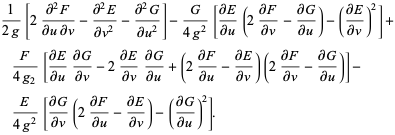
This answer is just a more elementary (but not simpler), more calculatory and less geometric way to express what Ivo Terek and Ted Shifrin described.
Let $U \subset \mathbb{R}^2$ be an open set (which we don't exactly know for the moment) and let $\psi : U \to \mathbb{R}^2 : (x,y) \mapsto (u,v)$. Its derivative $D\psi$ is represented (in coordinates) by a matrix
$$ \left( \begin{array}{cc} \partial_x u & \partial_y u \\ \partial_x v & \partial_y v \end{array} \right) =: \left( \begin{array}{cc} A & B \\ C & D \end{array} \right) \, .$$
Assume that the Euclidean metric on the $(u,v)$-plane has the expression $y^2 dx^2 + x^2 dy^2$ with respect to the coordinates $(x,y)$. This means that $A^2+C^2 = y^2$, $B^2+D^2 = x^2$ and $AB+CD = 0$. By inspection, we see that setting $A= y \cos(f(x,y))$, $B=-x \sin(f(x,y))$, $C=y \sin(f(x,y))$ and $D = x \cos(f(x,y))$ with $f$ any function, we satisfy these three equations.
(Observe that this 'inspection' can be conceptually justified by first renormalizing the vectors $(D\psi) \partial_x$ and $(D \psi) \partial_y$ to be (ortho)normal as in Ivo Terek's answer and then performing an Euclidean rotation by an angle $f$ to the 'standard Cartesian orthonormal frame' as in Ted Shifrin's comment.)
Note however that $f$ has to be chosen in such a way that $A = \partial_x u$, etc. If such a choice exists, then since $\partial_y \partial_x u = \partial_x \partial_y u$, we have the constraint $\partial_y A = \partial_x B$, that is
$$ \cos f - f'_y y \sin f = - \sin f - f'_x x \cos f \, \mbox{ i.e } \, (1- f'_y y) \sin f = -(1 + f'_x x) \cos f. $$
With a similar reasoning for $v$, we have the constraint $\partial_y C = \partial_x D$ which yields
$$ \sin f + f'_y y \cos f = \cos f - f'_x x \sin f \, \mbox{ i.e } \, (1 + f'_x x ) \sin f = (1 - f'_y y ) \cos f. $$
This is possible only if $-f'_x x = 1 = f'_y y$, whence $$f'_x = -1/x \Rightarrow f = - \log x + g(y) \Rightarrow f'_y = g'(y) = 1/y \Rightarrow g(y) = \log y + C \, .$$
We thus obtain $f(x,y) = \log(y/x) + C$ for some constant $C$, which we shall choose to be $0$ for simplicity. We now know what should be the functions $A, \dots, D$ if the function $\psi$ is to exist (because of the Poincaré lemma, if $U$ is simply-connected, such a map $\psi$ exists ; note also that for $A, \dots, D$ to be defined, the coordinates $x$ and $y$ can't vanish on $U$).
What remains to be done is to compute $u$ and $v$...
Observe that setting $U = -xy \sin \log(y/x)$ and $V = xy \cos \log(y/x)$, we get $\partial_x U = -C + A$, $\partial_y U = B -D$, $\partial_x V = A + C$ and $\partial_y V = D + B$. It is easy from there to check that $u = (U+V)/2$ and $v = (V-U)/2$ are solutions to the problem.