Gaussian curvature is a kind of like an infinitesimal curvature. For example, all points of a sphere has positive Gaussian curvature. Angular defect is kind of like a "point charge" of curvature. For example a cube has positive angular defect at its 6 corners.
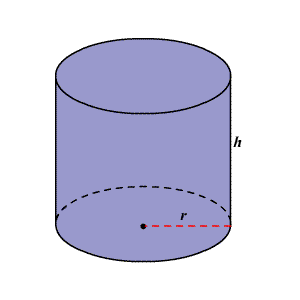
So what do you call the curvature on the two circles of a cylinder? It has positive infinite gaussian curvature, but 0 angular defect.
Note: The cylinder is closed, i.e. has a top and bottom (like this).

This is not a definite answer, just a collection of ideas, before they close down the question.
This is an interesting question. It refers to a finite cylinder $C$ closed by two top and bottom disks. The resulting "surface" $S:=\partial C$ is homeomorphic to $S^2$. On the smooth parts of $S$ the Gaussian curvature is $0$. On the other hand by the Gauss-Bonnet theorem the total curvature of $S$ is $4\pi$. In the case of a convex polyhedron $P$ this total curvature is concentrated in a $\delta$-function like way in the vertices of $P$. In the case of $S$ it is concentrated in the two circular "edges" of $S$. The total tangent turning along these edges is $4\pi$. A proper definition of the "Gaussian curvature density" would therefore lead to the value $1$ per unit of tangent turning along the "edges". But the angle between the tangent planes along the edges should also play a rôle. A limiting approach could be considering the parallel bodies $C_\epsilon$, $\epsilon\to0+$, of our cylinder. These have a smooth boundary, which consists of toroidal pieces of surface along the edges of $C$ whose Gaussian curvature we have under control.
I'm sure this problem has been dealt with somewhere. Unfortunately the people who might know about it have been excluded from sharing their knowledge with us.