Given a dartboard of radius r and infinite darts.How many minimum darts you need to throw so that you can be sure that the next dart you throw is strictly less than r distance from some previous dart? Note:-Every dart strikes on the dartboard.
2026-04-28 17:47:21.1777398441
 On
On
On
On
On
On
On
On
Dartboard puzzle.
1.3k Views Asked by Bumbble Comm https://math.techqa.club/user/bumbble-comm/detail At
5
There are 5 best solutions below
0
On
If there is no guarantee where the darts land on the dartboard, then there is no finite answer to the question. (See SE318's answer)
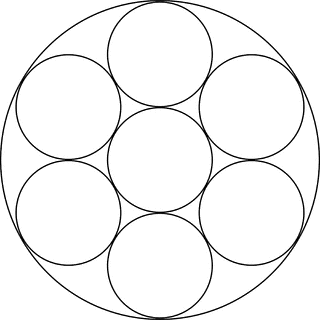
If you know that the first $N$ darts all fall at least $r$ distance apart from one another, then the question is equivalent to packing circles of radius $\frac{r}{2}$ inside a larger circle of radius $r+\frac{r}{2}=\frac{3r}{2}$. In this case the maximum is $N=7$; see Wikipedia/Circle packing in a circle.
4
On
The minimum number of darts needed to be thrown is $1$, a bullseye in the exact centre of the board. Then the entire board is within $r$ of a thrown dart.
0
On
I think minimum dart is 4, after these four are landed on A, B, C and D points then you are definitely sure that it will land within radius r from some previous dart.

0
On
The minimum number of darts to throw is seven, and the way the seven darts can fit in the circle without failing to accomplish the constraint is this: one of them lands in the center, and the other six in the circumference of the board, equidistant from each other (unless you don't consider the circumference to be part of the board, and then the number of darts is five). The side of the inscribed hexagon is equal to the radius, so that's that.
The best way to see that the eighth dart will land within a distance smaller than the radius from some other dart is this: imagine that each dart is the center of a circle of radius $\frac{r}{2}$. If you want the darts to be in the circle, the dart-generated circles must be inside a circle of radius $r+\frac{r}{2}$ concentric to the first, and if you want them to be separated by a distance bigger than $r$, the little circles must be exterior to each other. As it isn't possible to fit more than seven circles of radius $\frac{r}{2}$ inside one of radius $r+\frac{r}{2}$, the minimum number of darts is seven.

(source: usf.edu)
You cannot guarantee this since for example you can throw infinitely many darts right near the leftmost part of the circle and at any step you could have hit on the rightmost part giving you a distance greater than r.