If $\alpha' ,\beta' ,\gamma'$ and $\alpha'' ,\beta'' ,\gamma'' $ are the direction angles of two lines, we have to find $\alpha ,\beta ,\gamma $ such that they are the direction angles of a third line perpendicular to both.
MY SOLUTION
I understand there are three equations like this:
- $\sum \cos \alpha\cdot \cos \alpha ' = 0 $
- $\sum \cos \alpha\cdot \cos \alpha '' = 0 $
- $\sum \cos \alpha\cdot \cos \alpha = 1 $
$$\begin{bmatrix} \cos \alpha & \cos \beta & \cos \gamma\\ \cos \alpha' & \cos \beta' & \cos \gamma' \\ \cos \alpha'' & \cos \beta'' & \cos \gamma'' \end{bmatrix}\begin{bmatrix} \cos \alpha\\ \cos \beta\\ \cos\gamma \end{bmatrix} = \begin{bmatrix} 0\\ 0\\ 1 \end{bmatrix}$$
By Cramer's rule, I arrive at: $$\cos \alpha = \frac{\cos \beta'}{\cos \beta' \cos \gamma'' - \cos \beta'' \cos \gamma'}.$$
But the answer given is somewhat different, given as $$\lambda \cdot \cos \alpha = \cos \beta' \cos \gamma'' - \cos \beta'' \cos \gamma'.$$
Where am I going wrong?
EDIT
The RHS should be $[1, 0, 0]^T$ rather than $[0, 0, 1]^T$ as pointed by Inquest. But my answer eludes me even more.

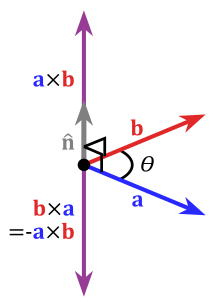
$\def\ca{\cos\alpha} \def\cb{\cos\beta} \def\cc{\cos\gamma} \def\l{\lambda} \def\det{\mathrm{det}\,} \def\VA{{\bf A}}$Let $$A = \left(\begin{array}{ccc} \ca & \cb & \cc \\ \ca' & \cb' & \cc' \\ \ca'' & \cb'' & \cc'' \end{array}\right).$$ Denote the $i$th row by $\VA_i$ and let $\l = \det A$. Then $|\l|$ is the volume of the parallelepiped defined by $\VA_1$, $\VA_2$, and $\VA_3$. Since $\VA_1$ is perpendicular to the other vectors and has unit magnitude, $|\l|$ is the area of the parallelogram defined by the vectors $\VA_2$ and $\VA_3$. Therefore, $|\l| = \sin\theta$, where $\theta$ is the angle between the two vectors. Note in particular that $|\l|$ does not depend on $\alpha$, $\beta$, or $\gamma$. This argument could be written to avoid the terminology of vectors, but it would be cumbersome.
By Cramer's rule $$\begin{eqnarray*} \ca &=& \frac{% \left|\begin{array}{ccc} 1 & \cb & \cc \\ 0 & \cb' & \cc' \\ 0 & \cb'' & \cc'' \end{array}\right|}{% \left|\begin{array}{ccc} \ca & \cb & \cc \\ \ca' & \cb' & \cc' \\ \ca'' & \cb'' & \cc'' \end{array}\right|} \end{eqnarray*}$$ and so $$\ca = \frac{1}{\l}(\cb'\cc''-\cb''\cc').$$