If I have defined a vector field in cartesian coordinates as follows:
F = F = x z i + x y j + (x^2 + y^2) k
To find the divergence in cartesian coordinates is trivial as it is simply: z+x
However I stumbled upon a question which suggested using the formula for divergence (which i am unable to post on here due to being unable to post a picture but you can find it on this link : http://2.bp.blogspot.com/_XvrTyMj5b-k/SDUkG5zvh5I/AAAAAAAACBg/J6ZApS1btrk/s400/nablaOperationsCylindrical.png)
How would i be able to apply this formula on the given vector field considering the vector field is given in terms of vectors i j k as opposed to theta r and z. I understand that i can switch z with rcos(theta( and y with r sin(theta) but its the vectors which are confusing me and i am unsure how to deal with them.

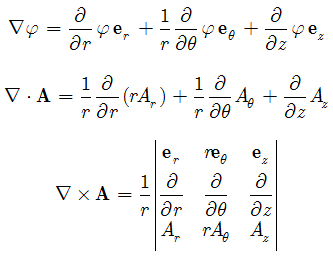
You can write $\mathbf{F}$ in cylindrical coordinates and then calculate the divergence using the formula you mentioned. In your case, we have
$$ \mathbf{F}(r,\theta,z) = (zr \cos \theta) \cdot \mathbf{i} + (r^2 \cos \theta \sin \theta) \cdot \mathbf{j} + r^2 \cdot \mathbf{k} = \\ (zr \cos \theta ) \left( \cos \theta \cdot \mathbf{r} - \sin \theta \cdot \pmb{\theta} \right) + (r^2 \cos \theta \sin \theta) \left( \sin \theta \cdot \mathbf{r} + \cos \theta \cdot \pmb{\theta} \right) + r^2 \cdot \mathbf{z} = \\ r\cos\theta(z \cos \theta + r \sin^2 \theta) \cdot \mathbf{r} + r \cos \theta \sin \theta (r \cos \theta - z) \cdot \pmb{\theta} + r^2 \cdot \mathbf{z} $$
Then
$$ \operatorname{div} \mathbf{F} = \frac{1}{r} \frac{\partial}{\partial r} \left(r^2 z \cos^2 \theta + r^3 \cos \theta \sin^2 \theta \right) + \frac{1}{r} \frac{\partial}{\partial \theta} \left( r^2 \cos^2 \theta \sin \theta - rz \cos \theta \sin \theta \right) + \frac{\partial}{\partial z} (r^2) = \\ 2 z \cos^2 \theta + 3 r \cos \theta \sin^2 \theta + r(\cos^3(\theta) - 2 \cos \theta \sin^2 \theta) + z \sin^2 \theta - z \cos^2 \theta = \\ z(\cos^2 \theta + \sin^2 \theta) + r \cos \theta (\sin^2 \theta + \cos^2 \theta) = z + r \cos \theta. $$
Alternatively (with much less work), you can just transform the cartesian divergence to cylindrical coordinates and get the answer. Namely,
$$ \operatorname{div}\mathbf{F} = z + r \cos \theta.$$