As the answers to this question (I think) successfully argue, it is often more useful to consider manifolds as intrinsically, i.e. without reference to an ambient Euclidean space. I am wondering if I have found a simple example of this phenomenon.
Consider the torus trefoil knot: 

It can be embedded into $\mathbb{R}^3$, as the above pictures hopefully illustrate. What is perhaps surprising, however, is that it is in fact homeomorphic to the regular torus in $\mathbb{R}^3$ (I think).
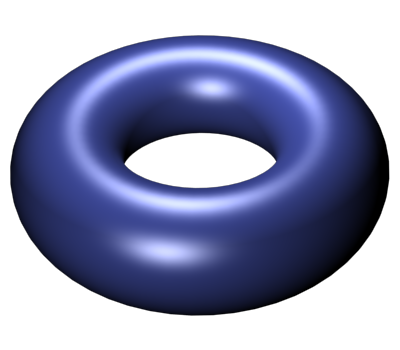
Question: Is it impossible to "unknot" the trefoil torus into a regular torus without leaving $\mathbb{R}^3$? I.e. does any homeomorphism between the two "factor through a higher dimensional space"?
Does this impossibility (if it is true) show the need for abstract manifolds? I.e. is this a concrete example where ambient spaces actually make things more confusing, rather than less?
The only homeomorphisms I can think of which "take place in $\mathbb{R}^3$" involve self-intersections, which, being "unphysical", I think implies factoring through a higher dimensional space. The same might be true for cutting the knot, "untying it", and then reattaching it at the same two places it was cut.

Your question doesn't quite make sense. The torus, $T_1$, as a manifold, and the trefoil, $T_2$, as a manifold, are homeomorphic because there's a bicontinuous map between them.
On the other hand, the pair $(R^3, T_1)$ and $(R^3, T_2)$ are not homeomorphic as pairs: there's no bicontinuous map from $R^3$ to $R^3$ whose restriction to $T_1$ gives a bicontinuous map from $T_1$ to $T_2$. (This requires some proof, of course.)
You can also think of $Q = S^1 \times S^1$ as a manifold; the torus $T_1$ that you've drawn above is the image of $Q$ under an embedding (a locally maximal-rank injective map $f_1$ from $Q$ to $R^3$), as is $T_2$ (with map $f_2$. Asking whether you can "untie" the torus amounts to asking if there's a homotopy, i.e., a continuous map $$ H: Q \times [0, 1] \to \mathbb R^3 $$ with the property that $H(p, 0) = f_1(p)$ and $H(p, 1) = f_2(p)$, and the property that $p \mapsto H(p, t)$ is an embedding for every $t$ and that $H$ is $C^1$ smooth (which prevents the so-called "bachelor's isotopy). There is no such homotopy (which again requires proof). [Alternative; you can ask for an ambient isotopy...and again no such thing exists.]
If you regard $\mathbb R^3$ as being in $\mathbb R^4$, though, you can ask whether there's a homotopy from $Q \times [0, 1]$ to $\mathbb R^4$ which looks like $f_1$ and $f_2$ at its two ends and is smooth and for each fixed $t$ is an embedding; the answer to that is "yes". So in that sense, you can untie a trefoil in 4-space, but not in 3-space.