When you plot the function for a reasonably large $k$ ($300$ in this case) you get something like this...
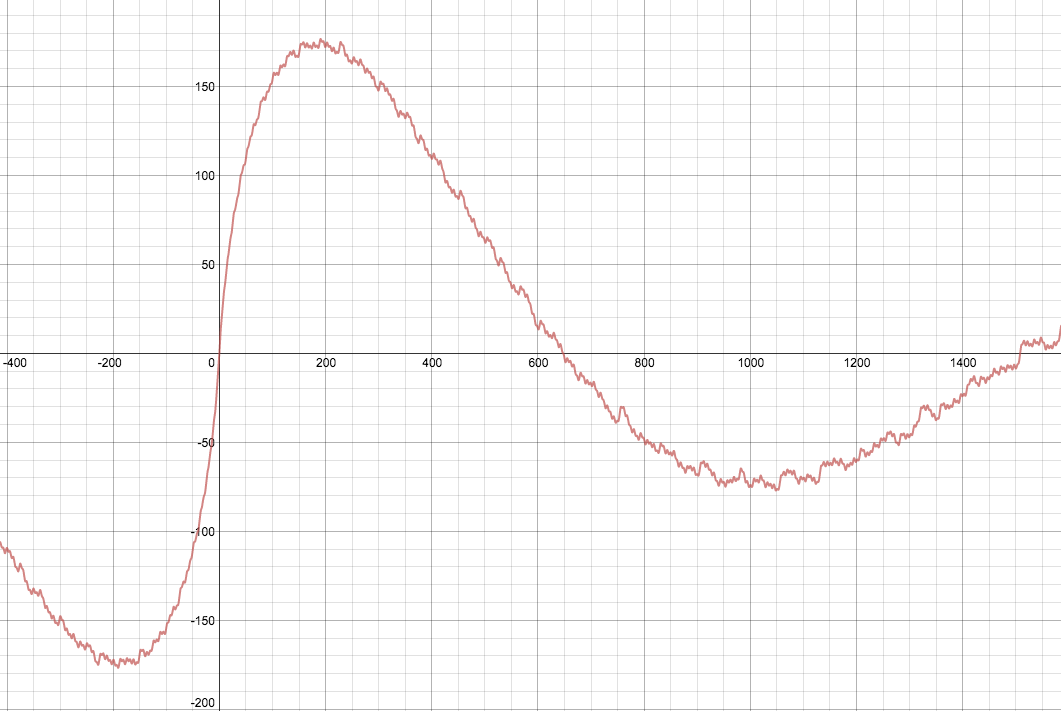 This seemed like it could be estimated the way I stated previously. The accuracy of that estimation would be perfect at $x=0$ and deteriorate as you progressed from there.
I tried to tackle this with some brute force by computing roots and local max/minima and trying to find functions to their patterns. Here's the data. The data is quite crude, it is just raw points and no local averaging was done.
The frequency of the estimation must very quickly reach a constant as $x$ is increased.
Derivative at $0=H_k$, where $H_k$ is the $k$th harmonic number.
The Position $(x,y)$ of the global maximum value is roughly $(0.62k, 0.58k)$.
EDIT:
- For large $x$ and $k$, if $|x|>10k$ then
$$\sum \limits _{n=1} ^k \sin \frac x n \sim \frac {k^2} {k+x} \sin \left( \frac x k + \frac \pi 2 \right) .$$
So now we need a function that tends toward that for large $x$ and is accurate for small $x$.
I am wondering if there is a smarter way to find the final estimation (accurate for all $x$) like using a certain number of terms from the Taylor expansion for $\sin(x)$.

Not exactly what you are seeking, but...
Let $$h(x,k)=\sum\limits _{n=1}^k \sin \frac x n$$ and normalize it: $$H(x,k)=\frac{1}{k}h(kx,k)=\frac{1}{k}\sum\limits _{n=1}^k \sin \frac{xk}{n}$$ This is a Riemann sum, so as $k\to \infty$ this tends to
$$H(x)=\int_0^1 \sin(x/t) \, dt = \sin(x) -x \,Ci(x)$$ where $Ci(x)$ is the cosine integral function.
The maximum occurs at $(0.6165,0.5782)$
Your approximation for large $x$, $\frac {k^2} {k+x} \sin \left( \frac x k + \frac \pi 2 \right)$, when normalized gives:
$$ H(x)\approx \frac{\cos(x)}{1+x}$$ which is consistent with the graph:
Further, doing a series expansion for large $x$ we get
$$ H(x) \approx \frac{1}{x}\left( \cos(x) + 2\frac{\sin(x)}{x} -6 \frac{\cos(x)}{x^2} +\cdots \right)\approx \frac{\cos(x)}{x}$$
For small $x$ (say $| x | < 1$) a series expansion gives:
$$ H(x) =-x \log(x) +x (1 -\gamma) +\frac{x^3}{12}+O(x^5)$$