I am not math student and I don't do math professionally, so sorry for the stupid question (if it is such). I'm interested in Euler's identity:
$$e^{i \pi} + 1 = 0$$ or $$e^{i \pi} = -1.$$
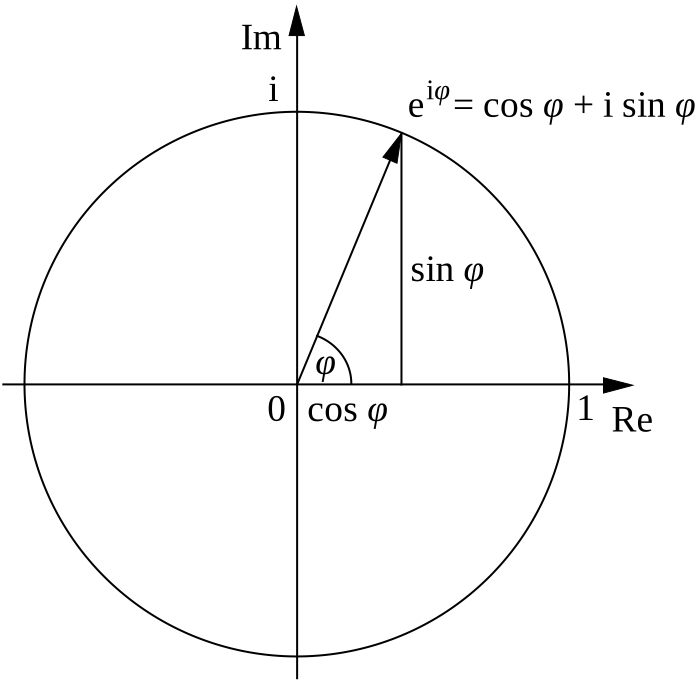
Is it the same as like $\qquad e^{ix}=\cos(x) + i\sin(x)$ ?
Can you give some physics or real life examples of using it and what's the difference between the two formulas.
I understand the idea behind $e^x$, simply explained it is the amount of continuous growth after a certain amount of time($x$). But why we use $\pi$ or $i$, in which cases and what they represent?
In which cases we multiply $e$ and in which we put it to the power of another number(difference between $e^x$ and $ye^x$)?
Some articles, books or videos will be helpful. I watched some, but they only explain how to prove the equation and how to find the derivative, not the using of it.



$\pi$ is the ratio of a circle's circumference to its diameter (which is a constant) and $i=\sqrt{-1}$ is a complex square root of $-1$.
First of all you have to understand what $e^x$ really is. There are several equivalent definitions but the one that is really important is the following:
$$e^x = \sum_{n=0}^{\infty}\frac{x^n}{n!}$$
It is the beauty of maths that it coincides with the classical powering operation. And it is important because this definition can be easily extended to complex numbers. Now over complex numbers it has the following property:
$$e^{a+bi}=e^a\cdot(\cos(b)+i\sin(b))$$
Without going into full details this follows from the fact that both $\cos(x)$ and $\sin(x)$ have a "nice" representation as an infinite series as well.
Now putting $a=0$ and $b=\pi$ brings the famous Euler's formula.