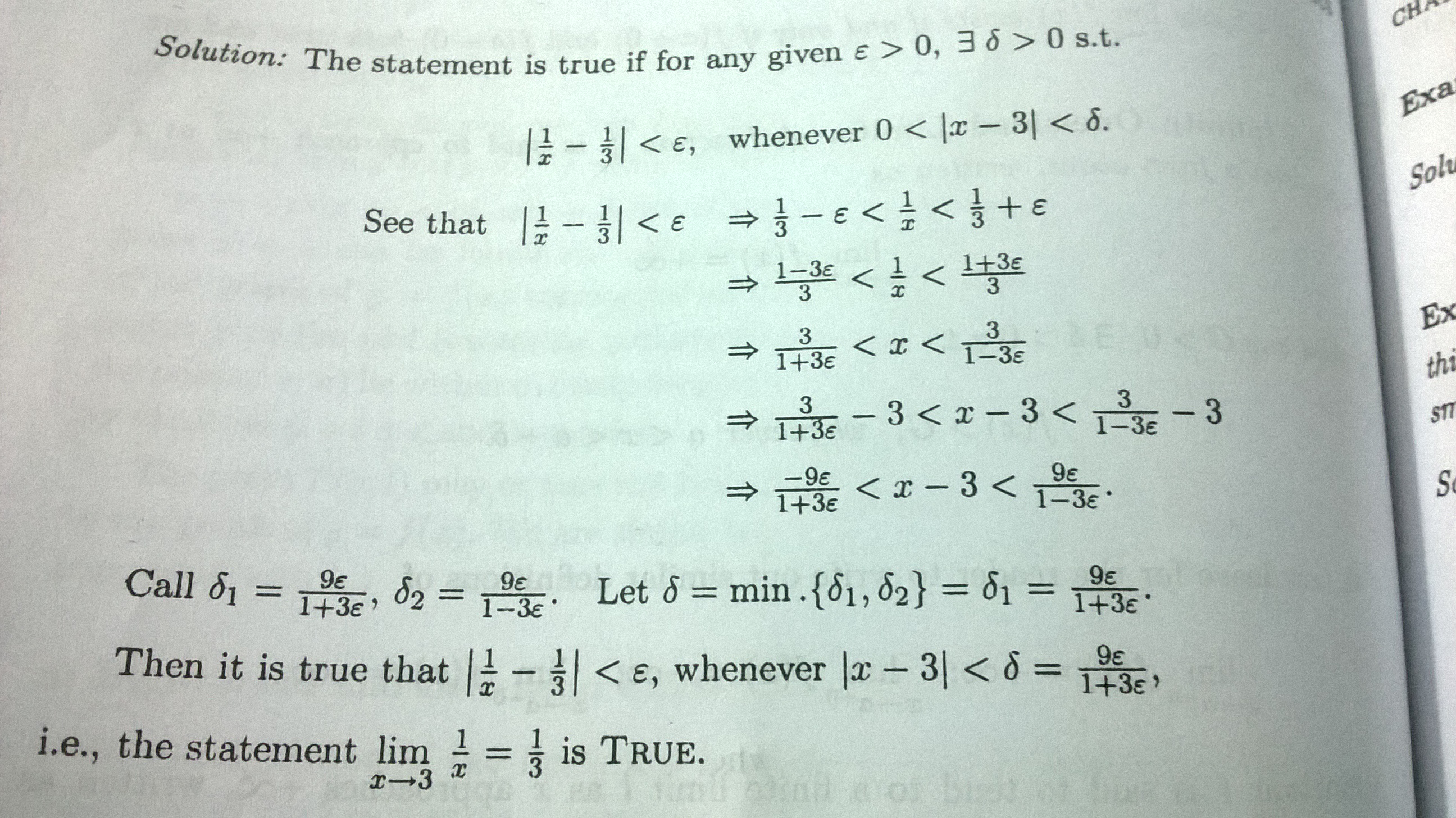
Above is the textbook proof that $\lim\limits_{x\to 3}\frac 1x=\frac 13$. I'm not sure if this is completely correct or not since I noticed that some of the implied inequalities doesn't hold $\forall~\epsilon\gt 0$. Take, for example, the inequality in the 4th line of the image :
$$\frac 3{1+3\epsilon}\lt x\lt \frac 3{1-3\epsilon}$$
that is implied by the 3rd line. That inequality doesn't hold, for say $\epsilon=2\gt 0$, i.e., there is no real $x$ for when $\epsilon=2$ that satisfies that inequality.
Also, I wonder why they took the $\min$ of $\delta_1$ and $\delta_2$ to be the $\delta$ since I think we should take the $\max$. This is because $-a\lt x\lt b\implies |x|\lt \max(a,b)~\forall~a,b\in\Bbb R$.
I'm pretty much a beginner at rigorous stuff like this, so I might be completely wrong in my thinking. I look forward to helpful responses from the community. Thanks.

Besides, the proof looks not good to me for the reason that it over-complicates and hence opaques the real deal.
I provide a proof of the limit statement for your reference in passing:
If $x \neq 0$, then $$ \bigg| \frac{1}{x} - \frac{1}{3} \bigg| = \frac{|x-3|}{3|x|}; $$ if $|x-3| < 1$, then $||x| - 3| \leq |x-3| < 1$ by triangle inequality, implying that $2 < |x|$, implying that $$ \frac{|x-3|}{3|x|} < \frac{|x-3|}{6}; $$ given any $\varepsilon > 0$, we have $|x-3|/6 < \varepsilon$ if $|x-3| < 6\varepsilon$. Putting all the previous things together, we conclude that, for every $\varepsilon > 0$, if $x \neq 0$ and if $|x-3| < \min \{ 1, 6\varepsilon \}$ then $$ \bigg| \frac{1}{x} - \frac{1}{3} \bigg| < \varepsilon. $$