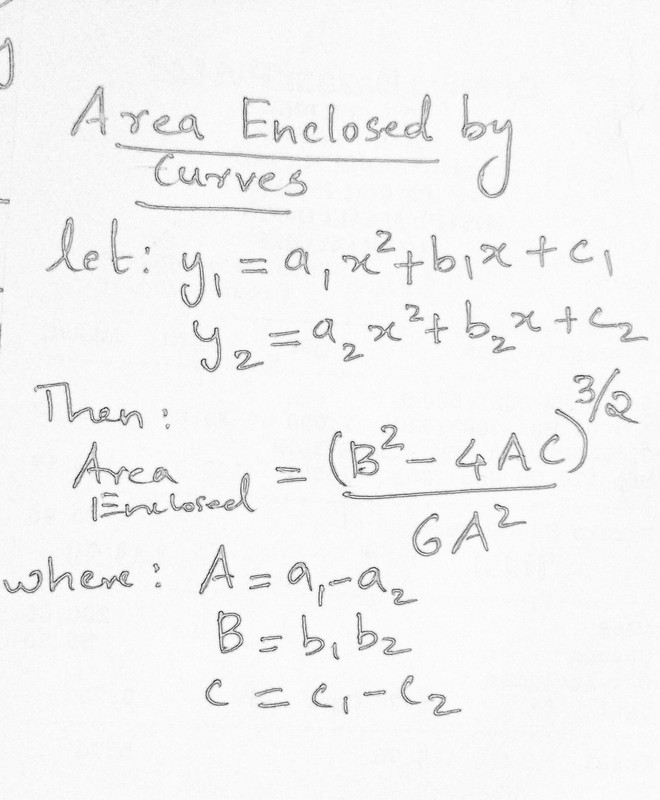
I have recently encountered a simple hands on formula to calculate the area between two quadratic curves:
$$\begin{align} y &= a_1 x^2 + b_1 x + c_1 \\ y &= a_2 x^2 + b_2 x + c_2 \end{align}$$
$$\text{area enclosed} = \frac{(B^2-4A C)^{3/2}}{6A^2}$$ where $$A := a_1 - a_2 \qquad B := b_1 - b_2 \qquad C := c_1 - c_2$$
Can anyone verify the consistency of this formula? I don't find it accurate to geometric level.

Subtracting the curves, we find that the $x$-coordinates of the points of intersection satisfy $$(a_1 - a_2) x^2 + (b_1 - b_2 )x + (c_1 - c_2) = 0 \tag{1}$$ so that, using the definitions of $A$, $B$, $C$, $$\{x_-,x_+\} = \frac{-B \pm \sqrt{B^2-4A C} }{2A} \tag{2}$$ A little symbol-crunching gives $$\begin{align} x_{+}-x_{-} &= \phantom{-}\frac{1}{A}\sqrt{B^2-4A C} \tag{3}\\[4pt] x_{+}^2-x_{-}^2 &= -\frac{B}{A^2}\sqrt{B^2-4A C} \tag{4}\\[4pt] x_{+}^3-x_{-}^3 &= \phantom{-}\frac{1}{A^3}(B^2-AC)\sqrt{B^2-4AC} \tag{5} \end{align}$$ Then, the signed area between the curves is given by the integral $$\begin{align} &\int_{x_-}^{x_+}(a_1 - a_2) x^2 + (b_1 - b_2 )x + (c_1 - c_2) \;dx \tag{6}\\[4pt] &= \int_{x_-}^{x_+}Ax^2 + Bx + C \;dx \tag{7}\\[4pt] &=\frac13A x^3+\frac12B x^2+Cx\;\big|_{x_-}^{x_+} \tag{8}\\[4pt] &=\frac13A(x_{+}^3-x_{-}^3)+\frac12B(x_{+}^2-x_{-}^2)+C(x_{+}-x_{-}) \tag{9}\\[4pt] &= \sqrt{A^2-4AC}\left(\frac13A\cdot\frac{1}{A^3}(B^2-AC) -\frac12B\cdot\frac{B}{A^2} +C\cdot\frac1{A} \right) \tag{10}\\[4pt] &= -\frac{(B^2-4AC)^{3/2}}{6A^2} \tag{11} \end{align}$$ Taking the absolute value gives the desired formula. $\square$
As @achillehui notes in a comment to the question (and, as is clear from $(2)$), we require $B^2-4AC\geq 0$ for the intersections to be real and the curves to meet. We also require $A\neq 0$; otherwise, the represented graphs are congruent parabolas that either coincide or meet only once.