Which sequences of adjacent edges of a polyhedron could be considered to be a geodesic? The edges of a face most surely will not, but the "equator" of the octahedron eventually will. But for what reasons? How do the defining property of a geodesic - having zero geodesic curvature - apply to a sequence of edges?
(One crude guess: any sequence of edges that pairwise don't share a face? What does this have to do with curvature?)

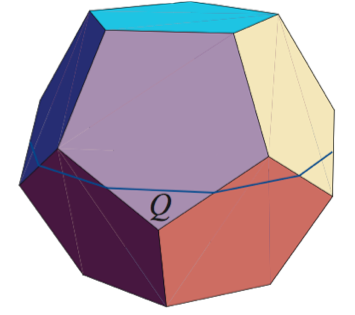
Some thoughts are given by Konrad Polthier and Markus Schmies, Straightest geodesics on polyhedral surfaces. Form the abstract:
Geodesic curves are the fundamental concept in geometry to generalize the idea of straight lines to curved surfaces and arbitrary manifolds. On polyhedral surfaces we introduce the notion of discrete geodesic curvature of curves and define straightest geodesics. This allows a unique solution of the initial value problem for geodesics, and therefore a unique movement in a given tangential direction, a property not available in the well-known concept of locally shortest geodesics.