I'm interested to know how do I evaluate this integral: $$\int_{1}^{\infty}\frac{y\cosh(yx)}{\sinh(y\pi)}dy.$$
Wolfram alpha gives the output $$\frac1{(\pi-x)^2}+\text{Li}(-2e^{-2\pi})-\frac{\log(1-e^{-2\pi})}{\pi}-\frac12+O(\pi-x).$$
Note: I have tried to put $x=y$ to show if the above integral easy for evaluation where I took $t=\tan\frac{x}{2}$ but I got a complicated form which I can't use some standard and simple trigonometric transformations for,
Thank you for any help.

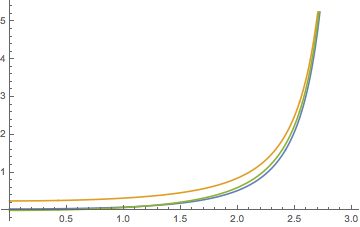
This may not be an answer to you mainly because there is perhaps no nice closed form, after all, according to what you like to call is "closed form" (an ever-evolving terminology depending on current knowledge of "elementary" functions).
Make the substitution $u=\pi y$ followed by $z=\frac{x}{\pi}$, and for convergence reasons assume $\vert z\vert<1$. Then, the given integral transforms to $$J:=\frac1{\pi^2}\int_{\pi}^{\infty}\frac{u\cosh(uz)}{\sinh u}du.$$ At this point, convert the hyperbolic functions into exponential and apply the geometric series $\frac1{1-e^{-2u}}=\sum_{k\geq0}e^{-2uk}$ to get (denoting $\alpha:=1-z$ and $\beta:=1+z$): \begin{align} J&=\frac1{\pi^2}\int_{\pi}^{\infty}\frac{u(e^{-u\alpha}-e^{-u\beta})}{1-e^{-2u}}du \\ &=\frac1{\pi^2}\sum_{k\geq0}\int_{\pi}^{\infty}u\left(e^{-u(2k+\alpha)}-e^{-u(2k+\beta}\right)du \\ &=\frac1{\pi^2}\sum_{k\geq0}\left(\frac{e^{-(2k+\alpha)\pi}}{(2k+\alpha)^2}+\frac{\pi e^{-(2k+\alpha)\pi}}{2k+\alpha}\right)- \frac1{\pi^2}\sum_{k\geq0}\left(\frac{e^{-(2k+\beta)\pi}}{(2k+\beta)^2}+\frac{\pi e^{-(2k+\alpha)\pi}}{2k+\beta}\right). \end{align} We recall the definition of the Lerch zeta function $$L(\lambda,a,s)=\sum_{k\geq0}\frac{e^{2\pi i\lambda k}}{(k+a)^s}.$$ As you can see, the integral $J$ may now be expressed as a linear combination of 4 Lerch values.
Caveat. Each of these 4 Lerch evaluations involve $i=\sqrt{-1}$, suggesting that one should be able (in theory) to combine (simplify) them in pairs since in the end $J$ should be real-valued.