I've returned to Aluffi's book (after getting the basics of groups from Herstein's) and I hit the same brick wall that made me put it aside. My general problem is this:
I can't seem to get used to commutative diagrams. This is mainly due to the fact that i'm not sure I'm translating them correctly and there's no one to tell me when I do. I'd like to know what should I do to become more comfortable with reading and writing diagrams.
And now for a specific example of me trying to translate a diagram about the definition of products:
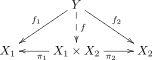
This is my parsing of the definition of products:
Let $\mathrm{C}$ be a category and Let $A, B \in Obj(\mathrm{C})$.
Let $\mathrm{C'}$ be a category obtained from $\mathrm{C}$ as follows:
Take the objects of $C'$ to be tuples $f = (f_A,f_B)$ where $f_A \in Hom_{\mathrm{C}}(F,A)$ for some $F \in Obj(\mathrm{C})$ (and $f_B \in Hom(F,B)$)
For every $f,g \in \mathrm{C'}$ let $\sigma \in Hom_{\mathrm{C'}}(f,g)$ iff $\sigma \in Hom_{\mathrm{C}}(F,G)$ (where $F$ and $G$ are the "domains" of $f$ and $g$ respectively) and $f \circ \sigma = g$ (I can't seem to formulate the definition without requiring that the morphisms themselves have some kind of product. what is happening here exactly? 2-categories?).
If $\mathrm{C'}$ has a final object $\pi = (\pi_A,\pi_B)$ it is said that $\mathrm{C}$ has a product object $A \times B$ which is the "domain" of $\pi$.
Is this a right way for interpreting the univeral property of the product?
ADDED: By "domain" of $f \in Hom_{\mathrm{C'}}(A,B)$ I mean the object $F$ in $\mathrm{C}$ such that $f_A \in Hom_{\mathrm{C}}(F,A)$ and $f_B \in Hom_{\mathrm{C}}(F,B)$.

What you have said is essentially correct (although you should have $f = g \circ \sigma$ in order to have $\sigma \in \text{Hom}_{C'}(f,g)$). Defined this way, the product is seen as a special case of a limit. By the way, it might help to take the objects of $C'$ instead as triples $(F, f_A, f_B)$, thus avoiding confusion about the source of $f_A$ viewed as an arrow in $C$, or as part of the data of an object in $C'$.
As commented above though, the limit definition can seem a bit convoluted at first, especially for such an intuitive notion as a product. A more concrete way to view products is as a representing object: given $A \in \text{Ob}(C)$, there is a functor $h_A : C \to \textbf{Set}$ given by $X \mapsto \text{Hom}_C(X,A)$. Given objects $A, B$ of $C$, you can take the functor $h_A \times h_B$ from $C$ to $\textbf{Set}$, sending $X$ to the set $\text{Hom}_C(X,A) \times \text{Hom}_C(X,B)$. The product $A \times B$, if it exists, is the object of $C$ representing this functor.
Both of these definitions encapsulate the fundamental property of a product: to give a morphism to a product is the same data as giving morphisms to each factor, or symbolically, $\text{Hom}_C(X, A \times B) \cong \text{Hom}_C(X,A) \times \text{Hom}_C(X,B)$. This property is really what is used in practice, and the fact that this can be expressed using a commutative diagram can be viewed as just convenient.